// [cafeteria]
The 2026 Food Edit: Gen Next Talks Food Trends
Gen Next spent 17+ hours talking food on [cafeteria] — almost 200 people spent enough time to cold-proof a sourdough loaf. They talked about the trends they want on their shelves and the ones they would scroll past on their feeds.
The 2026 Food Trend Index
[cafeteria] and Listen partnered to explore the trends that make it off the feed and onto the fork.
Spice Isn’t Niche
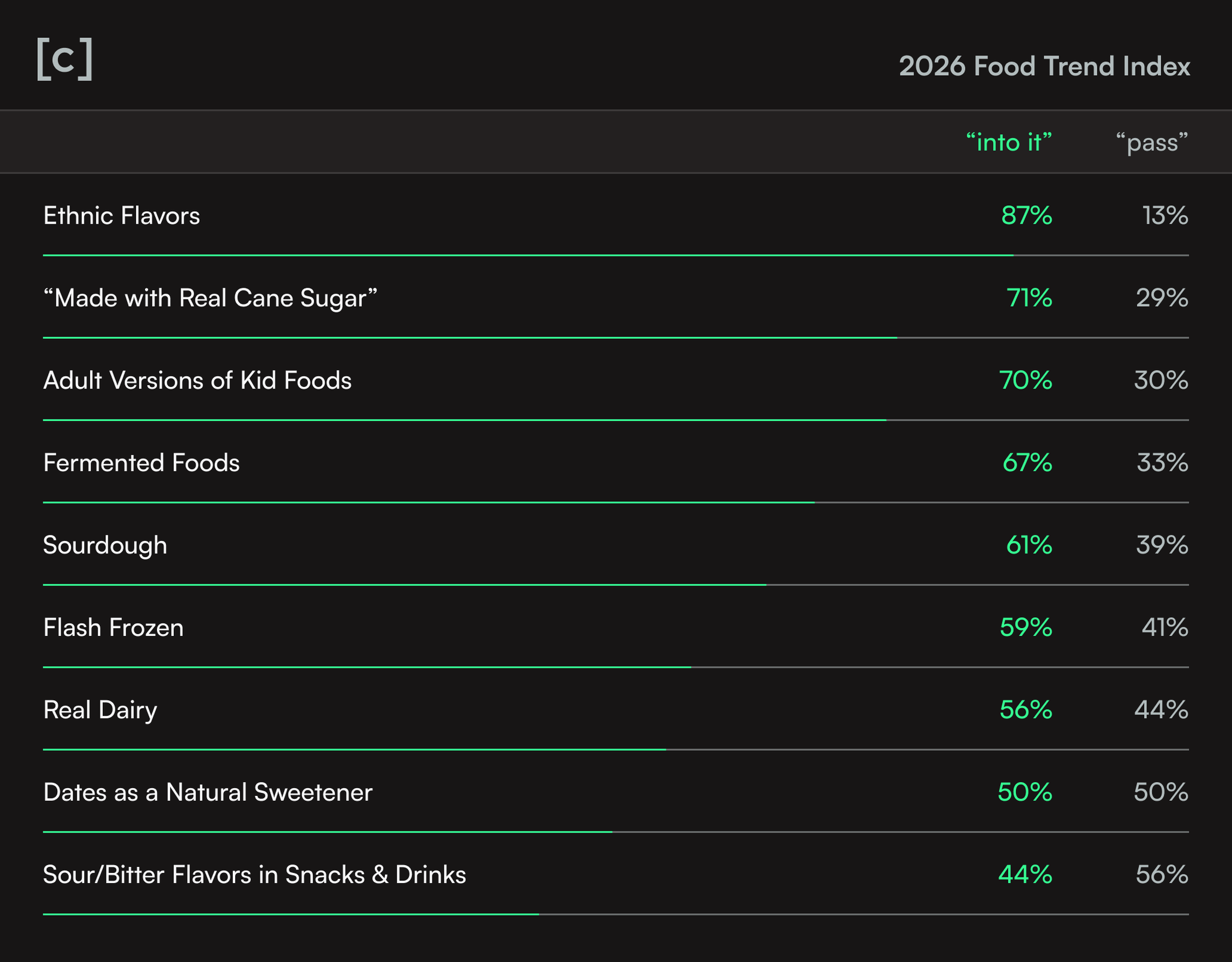
Gen Next is bored with “bland”. 87% want more international flavors to feature in their everyday foods.
American food staples (burgers, fries, pizza) are perceived as bland, under-seasoned, and limited. 60% want more international flavors because they’re tired of eating the same thing.
Some frame international food as healthier: better ingredients and more nutrient-dense cooking traditions.
- A smaller but vocal group frames it as cultural appreciation with conditions: do it authentically, price it fairly, and involve the culture.
- Those from diverse backgrounds aren’t asking for something new. They’re watching the mainstream catch up to what they already eat.
“I’m into it because we need more diverse food instead of just regular American foods. People need to expand their palate and not eat the same thing every day. Try new flavors. It may be good because I have tried Latin American, Indian, and Asian flavors, not Middle Eastern though.”0:00
“I love Chipotle and Halal food, and I love experiencing food of different culture. I’m just not a big fan of bowl foods anymore. I think the concept of a bowl-style restaurant like Chipotle is kind of getting stale.”0:00
“these cultural foods have more flavor and are probably have more health benefits than typical american food”
“The USA has such homogenous flavors, and not much creativity. I remember seeing videos of fast food in other countries where they show all the cool different flavors they have at fast food and convenience stores. We have a lot of variety here, but not as much in the flavor realm.”
“I’m Asian myself and I love seeing Asian flavors so other people can explore and try. However, I don’t like seeing companies attempt it without an Asian company or food maker to advise them because a lot of times, it feels gimmicky and they don’t do the flavors right.”
The Global Grocery List
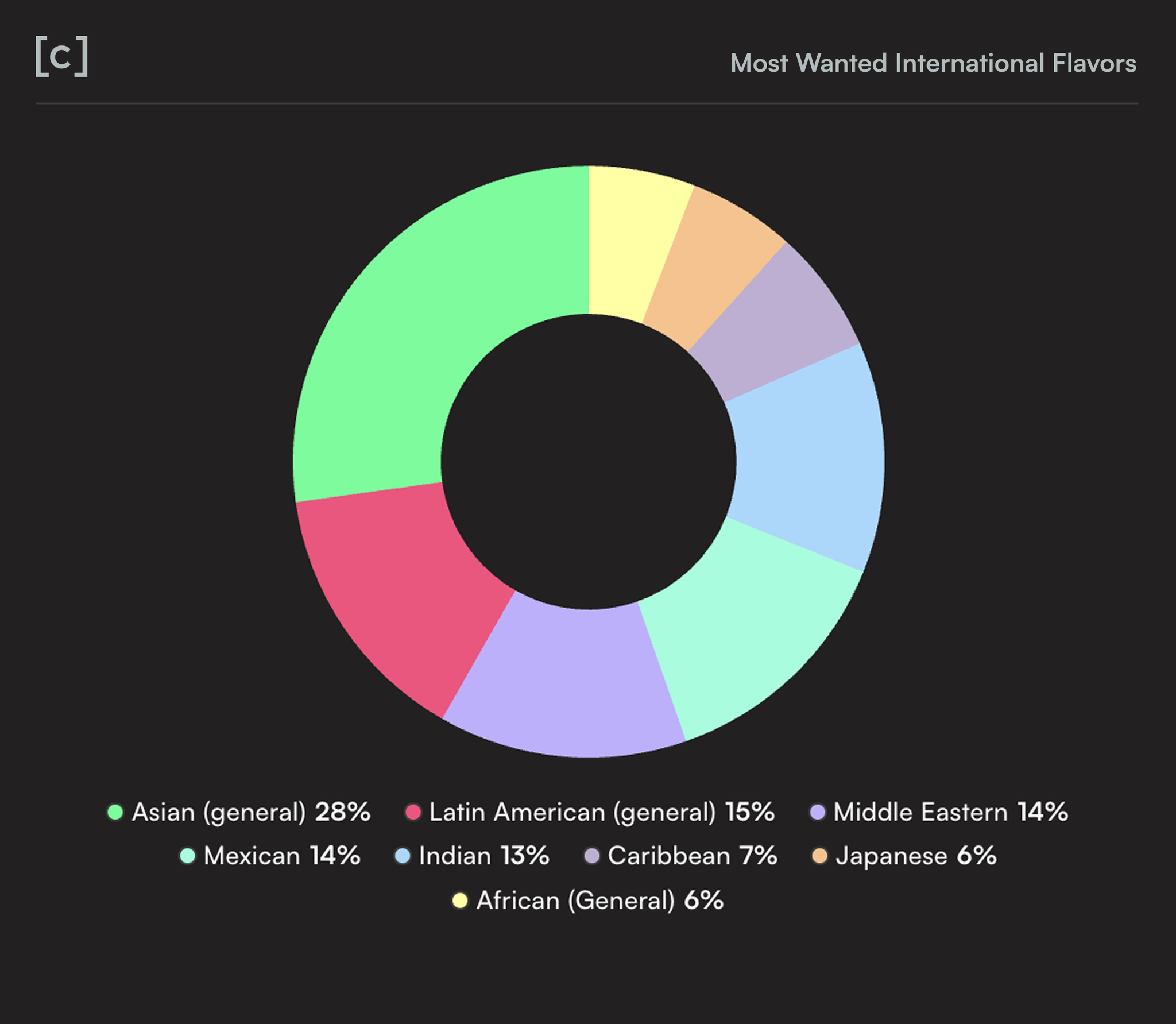
Asian flavors lead international demand. Middle Eastern cuisine interest is growing.
We asked Gen Next what international flavors they want to see more of, and 28% said “Asian” without naming a specific cuisine. Among those who do get specific: Indian leads followed by Japanese.
Middle Eastern ties Indian at 13-14% - notable given limited distribution into shelves compared to Asian or Latin American cuisine.
Caribbean demand is 80% Jamaican-driven. For African cuisine, the majority didn’t name a specific country or region.
“Asian food all the time, like anything like Japanese or Chinese, absolutely, in my stomach now.”0:00
“middle eastern. I feel like there’s already a heavy emphasis on Latin American and Asian flavors because they’re popular”
“I need to see some more Indian food incorporated everywhere”
Not In My Snacks
More than half of Gen Next says sour and bitter flavors don’t belong in their snacks and drinks.
56% passed on sour and bitter flavors in snacks and drinks and 21% think this trend is overhyped. But the rejection isn’t equal across both flavors.
Among those into the trend, over half explicitly endorse sour flavors (pickles, lime, tart candy, dill chips). Only about 10% are positive about bitter.
“I think those flavors are in the right amount of things like there are pickle chips and pickle a bunch of pickle things and they have like sour candies and stuff I think that’s perfectly fine I would never eat like bitter herb chips I think they do enough with all the like sour and bitter flavor things and there’s like a big sour trend too I feel like they they’re doing enough”0:00
“The whole point of snacks are to taste good, and it’s like a short little way to fill you up. And if you put sour and bitter flavors into it, then it just defeats the whole purpose.”0:00
“bitter is by far the worst flavor profile. grapefruit is disgusting to me. sour I love in candy, but it would be too acidic for normal snacks and would cause some stomach issues.”
“just not my cup of tea. I don’t like anything bitter or tart. I like certain sour candy but I don’t think I’d go to the store looking for things I know will be bitter”
Real Sugar Means Real Everything
Gen Next reads “made with real cane sugar” as a signal about the entire product. If the sugar is real, the rest probably is too.
71% are into brands emphasizing “made with real cane sugar” on the label over artificial or alternative sweeteners.
- The dominant driver is a blanket preference for natural over artificial: real vs. fake, no chemicals, not processed.
- 22% say it’s about transparency: they want to know what’s in what they’re eating, and cane sugar on the label signals honesty.
- 16% name stevia or monk fruit aftertaste as a specific turn-off for artificial sweeteners.
The 29% who are not into real cane sugar aren’t necessarily against it. Many express indifference.
Females care at every age (stable at 74-78%). For males, the anti-artificial stance is learned: 55% of teens care. By age 23, it’s 81%.
“I definitely like when it says made with real cane sugar over like the artificial sweeteners because I feel like if it’s made with real cane sugar then every other ingredient they use is probably more holistic and like natural.”0:00
“It’s typically healthier. It’s not as slop-filled. High fructose corn syrup is terrible. Regular white sugar is also bad.”
“I think it’s nice to know that it’s made with like I think real cane sugar. I think some artificial sweeteners can sometimes leave a bizarre aftertaste like I’ve had iced tea sweetened with monk fruit before and it just tasted really off. While cane sugar even though maybe it doesn’t have a lower glycemic index it’s better for you than like straight sugar and like you know what taste you’re getting. I think that’s like a big thing.”0:00
“honestly makes no difference to me. i don’t really like the taste of artificial sweeteners in things like tea or coffee, but if it’s in a prepackaged thing, i usually don’t know the difference to be honest”
Divided On Dates
Half of Gen Next is open to dates as a sweetener in snacks and desserts. The other half can’t get past the taste.
Supporters see dates as a natural alternative. They cite the taste and health benefits (high fiber, natural sugars). The condition for many: the flavor needs to be invisible.
Even among supporters, the cost of dates is a concern.
The other half has a visceral aversion to the taste. Some also mention preference for “real” or “regular” sugar, or that dates are still sugar with comparable calories.
Males are slightly more open to using dates as sweeteners than females (54% vs. 43%).
“I’m super into it. I think it’s fun. I think it’s innovative. Dates are expensive though, so it kind of becomes like one of those things.”0:00
“I’m okay with it as long as I can’t tell that there’s dates in it without looking at the label.”
“I think dates are just like really high in calories and sugar and it’s better if you use like a zero calorie sweetener”0:00
“dates are great because if they’re high fiber, so they don’t spike blood sugar as much as straight up sugar as a sweetener. I also love the flavor of dates so I’m fully for this.”
Whole Milk, Short Shelf Life
56% of Gen Next prefer real dairy. The case for it is taste, protein, and a familiar argument: it’s real.
Plant-based gets the same dismissal as artificial sweeteners: fake, watered down, not the real thing.
Cottage cheese has its loyalists, who cite protein and convenience. But the backlash is louder: the texture, the look, and the fatigue of seeing it in every recipe.
For those who prefer plant-based, the most common reasons are physical (lactose intolerance, stomach issues, acne). But for some, it’s not either / or — it’s almond or oat milk in coffee, real dairy everywhere else.
81% of teen boys are pro-real dairy.
By their early 20s, the majority flip sides (only 35% pro-dairy). They are driven by lactose intolerance, plant-based exposure, or just wanting options.
But around age 23, the preference recovers: 57% are pro-dairy.
Gen Next females stay stable at 55-60% pro-dairy across all ages.
“Because almond, oat, etc. are fake milk, and cottage cheese, kefir, kefir, atum, and milk all have actual vitamins that your body needs, and they’re real food, not made in a factory.”0:00
“Give me my plant-based stuff. The other stuff just is too rich and it often doesn’t set well, whereas the plant-based stuff, I can just chill with it throughout the day.”0:00
“The plant based ones have too much chemicals.”0:00
“I’m lactose intolerant and most dairy products cause stomach and acne issues so I tend to avoid those and use milk alternatives”
The Gut Check
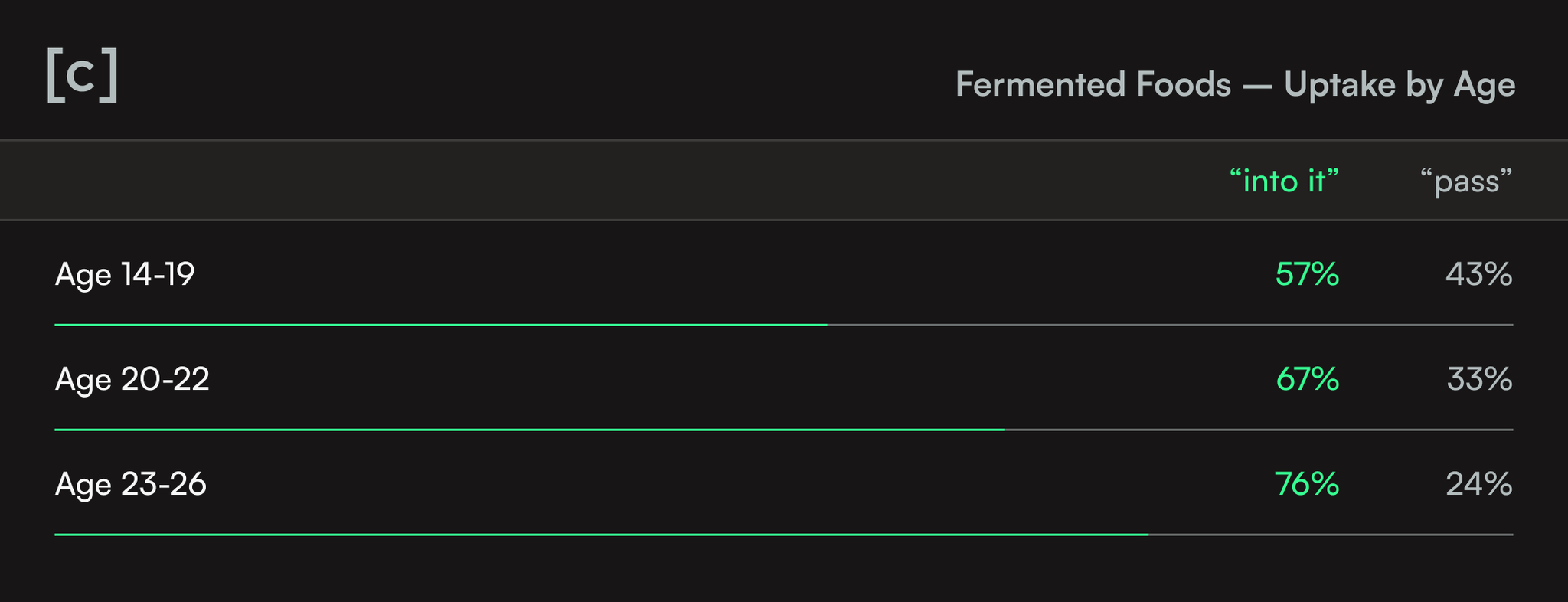
Gut health consciousness turns on in your 20s. 57% of teens are into fermented foods. By age 23, it’s 76%.
Health is a primary driver of fermented foods — half of supporters cite gut health or probiotics.
But taste pulls its weight too, with about a third saying they eat fermented foods because they taste good, and the health benefit is a bonus.
Among those who reject fermented foods, 27% say they like pickles but draw the line there.
“I’ve always loved pickles like regular like dill pickles kimchi I love it I could eat it every single day if like my stomach would let me and the fact that like now we know that it has benefits it’s just like an even more of a reason to like eat it”0:00
“I love kimchi, it’s so important to take care of your gut health and it’s the easiest way to do it. I need probiotics in my life”
“because they are natural probiotics. it isn’t a trend, that’s just a fact. they have gut healthy bacteria in them”
“I’m glad it’s a trend now. I’ve been eating sauerkraut and pickles and kimchi, been drinking kefir my whole life, and kombucha, and because it tastes good, you know. I don’t even do it for the health benefits, I just do it because it tastes good. But the health benefits are great too, and a lot of people are doing it now, so I’m into it, always into it. They taste good.”0:00
Don’t Stretch The Dough
Sourdough is equally popular across genders, but females claim it as their #1 favorite trend at 5x the rate of males.
Supporters are in it for the taste. As for the gut health narrative, some are hopeful agnostics – it’s an added bonus they’re not completely convinced by.
The other side is not entirely anti-sourdough — many are anti-overextension. They don’t love sourdough in their crackers, snacks, and desserts.
“It’s good for gut health and really trending right now. Everybody loves to make sourdough bread.”0:00
“I’m not sure if the sourdough cake thing is real or not. All I know is that anything homemade is probably better for you than the store-bought. So if you’re buying sourdough in a store with limited ingredients, that’s still better than bread with like 50,000 ingredients.”0:00
“I like sourdough by itself, but trying to include it in all these other snacks doesn’t seem to necessary | I like sourdough by itself but I don’t like how they’re trying to include it in everything”
“sourdough is so cool. a sourdough starter can literally last you for upwards of 10 years if you can keep it alive. theres so much to do with it so its less wasteful on top of just being good”
Earned Nostalgia
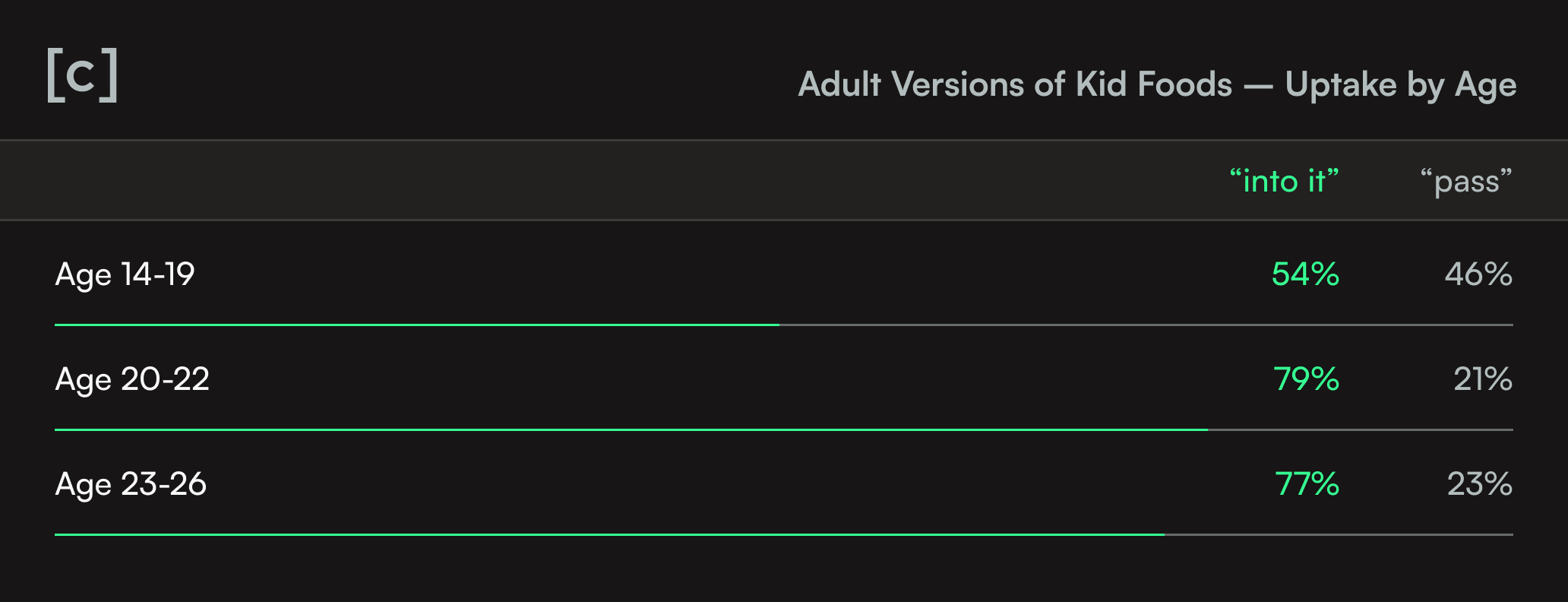
Only half of teen females want adult remixes of childhood favorites, but by age 23, 91% do. You have to leave childhood to miss it.
Males disproportionately want Lunchables back. Females gravitate toward gummy snacks, with Scooby-Doo snacks the most requested specific brand. Gogurt, Danimals, and Trix yogurts came up across genders.
The ask for remixes of childhood snacks: same nostalgia, better ingredients, adult portions.
“I think generally pasta dishes. I really enjoy pasta of all kinds and just like being able to kind of recreate recipes from your childhood to match up more with what your palate is as an adult.”0:00
“adult lunchables. with real food and large portions. could help with meal prepping too”
“they need to start getting more creative with cereals. so much untapped potential there! dude the dannimals yogurts too, just gogurts in general. like a probiotic gogurt would go crazy”
“i think i want to see chicken nuggets more as an adult food”
“You don’t really have a specific preference here. I love nostalgia, and I’ll buy it as one-offs, but nothing that I feel like would become a consistent purchasing behavior. I think a lot of the food in America has evolved past that point and has been proven not to be good for you on a consistent basis, so it is purely a nostalgia purchase.”
The First Apartment Kitchen
Flash frozen produce barely registers with Gen Z in their early 20s. But once they’ve moved out of their college dorms, approval nearly doubles.
43% of females ages 20-22 are into flash frozen vs. 78% of females 23-26.
The pro-flash frozen argument lands on affordability (cost savings, shelf life, access) and practicality (smoothies are the gateway).
The rejection is emotional, not rational. Among those who passed on flash frozen, freshness perception overrides the science.

“I’m honestly a huge proponent of frozen goods and stuff. I just find it so convenient and honestly it tends to be cheaper too. It requires less cutting and you can just like pop it in some boiling water and it’ll be good. Admittedly that’s how I eat a lot of my veggies and fruit.”0:00
“easier to just always have that on hand and you know it just like just in case so if I need all of a sudden I need peas and carrots in my fried rice and I have it frozen it’s perfect and I want fruit in my smoothie and all of a sudden I just have frozen fruit in my freezer like I like to stay stocked”0:00
“frozen foods are awesome!!! just as nutritious as fresh foods but often cheaper!!”
“freezing right after harvest locks nutrients at a ripeness so it could be just as good you know that sometimes better than fresh produce that’s sat in the transit and stuff”