// [cafeteria]
Are kids the CEOs of household spend?
How Gen Z and Gen Alpha are shaping what your customers want today and where demand goes next.
If your customers are mostly in their 30s and 40s, it’s tempting to view Gen Z and Gen Alpha through a purely future-focused lens.
It’s a perspective we hear often at [cafeteria], usually in the form of a question: “How will understanding younger consumers help us reach the customers buying from us today?”
Research points to an answer: younger consumers already influence what older generations buy. Some of that influence happens directly, through recommendations and family decisions. Their wider reach comes through culture, shaping how people discover brands and what becomes worth their attention.
Understanding that influence can help you see what’s driving demand among your customers today.
The Invisible Co-Signers
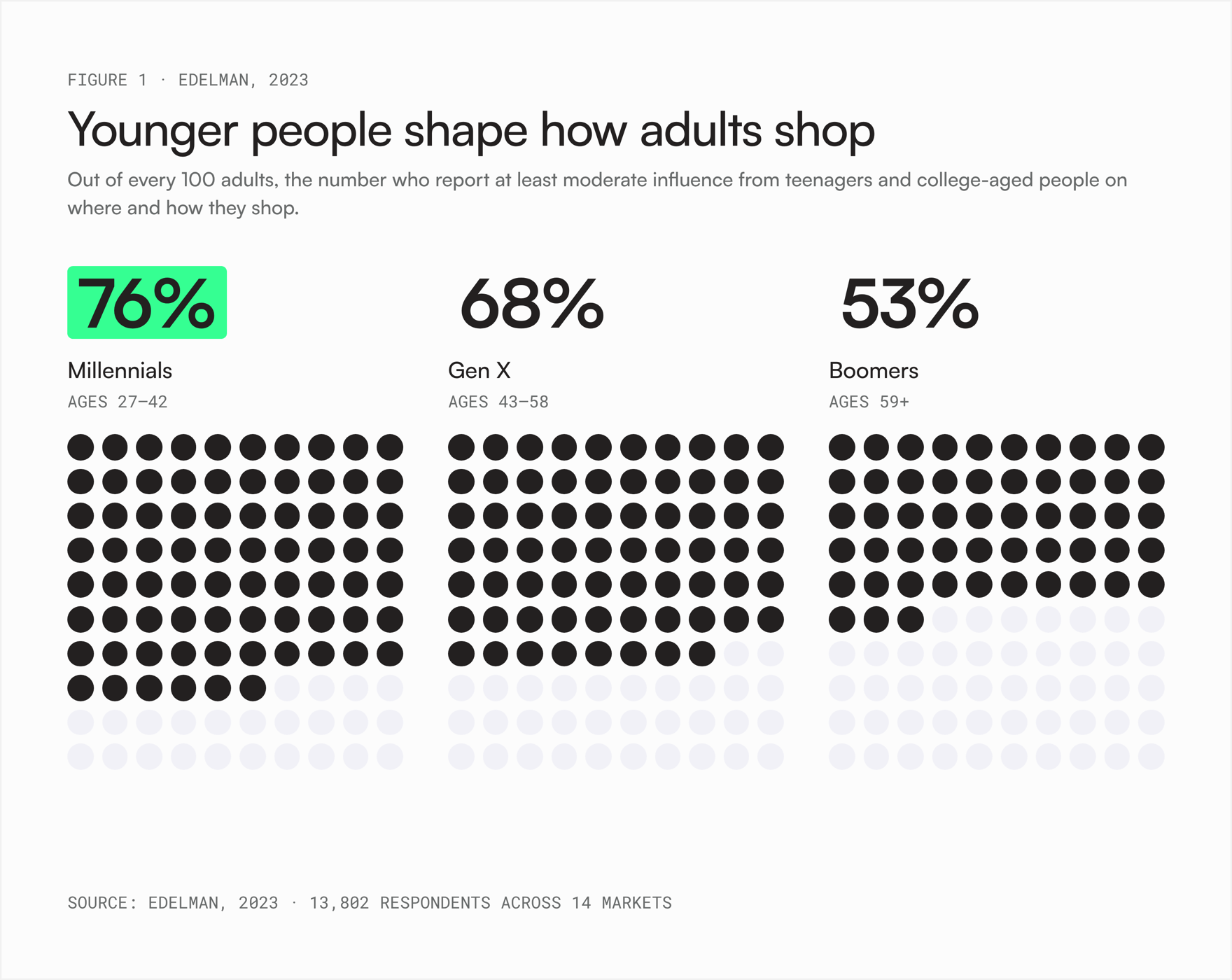
In Edelman’s 2023 research across 14 markets, 76% of Millennials said teenagers and college-aged people influenced where and how they shopped. That figure was 68% for Gen X and 53% for Boomers. [1]
It goes even deeper than simple shopping choices.
In a 2026 U.S. study from HarrisX and Allison Worldwide, 91% of parents said their Gen Alpha teens actively shape the brands they personally like. [2]
Parents aren’t just making peace with what their kids want for dinner. They are genuinely adopting their kids’ taste.
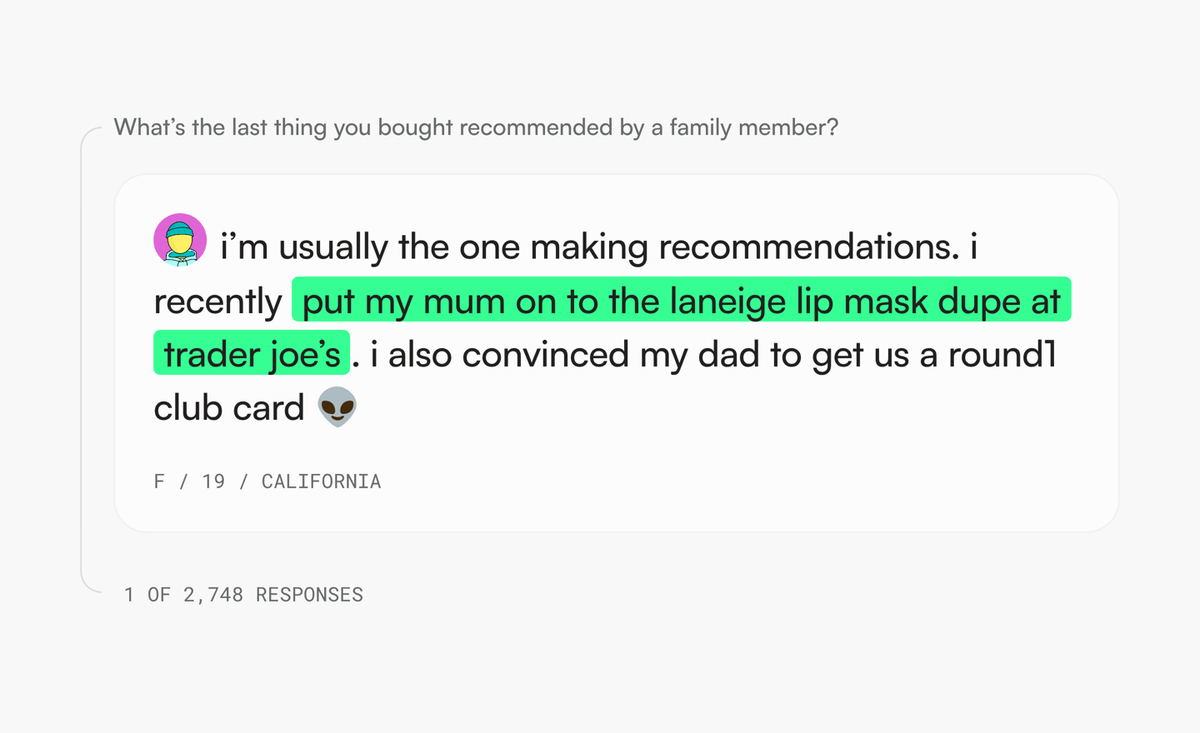
For marketers, this reveals a critical blind spot in how we measure demand: your core customer might be neatly mapped out in your data, but the person who turned them on to your brand in the first place might be completely invisible to you.
The shopping cart has collaborators.
PwC’s 2026 U.S. survey found that 52% of children ages 7–14 said they added items to shared online shopping carts for a parent to review. 60% said an adult paid when they bought something. [3]
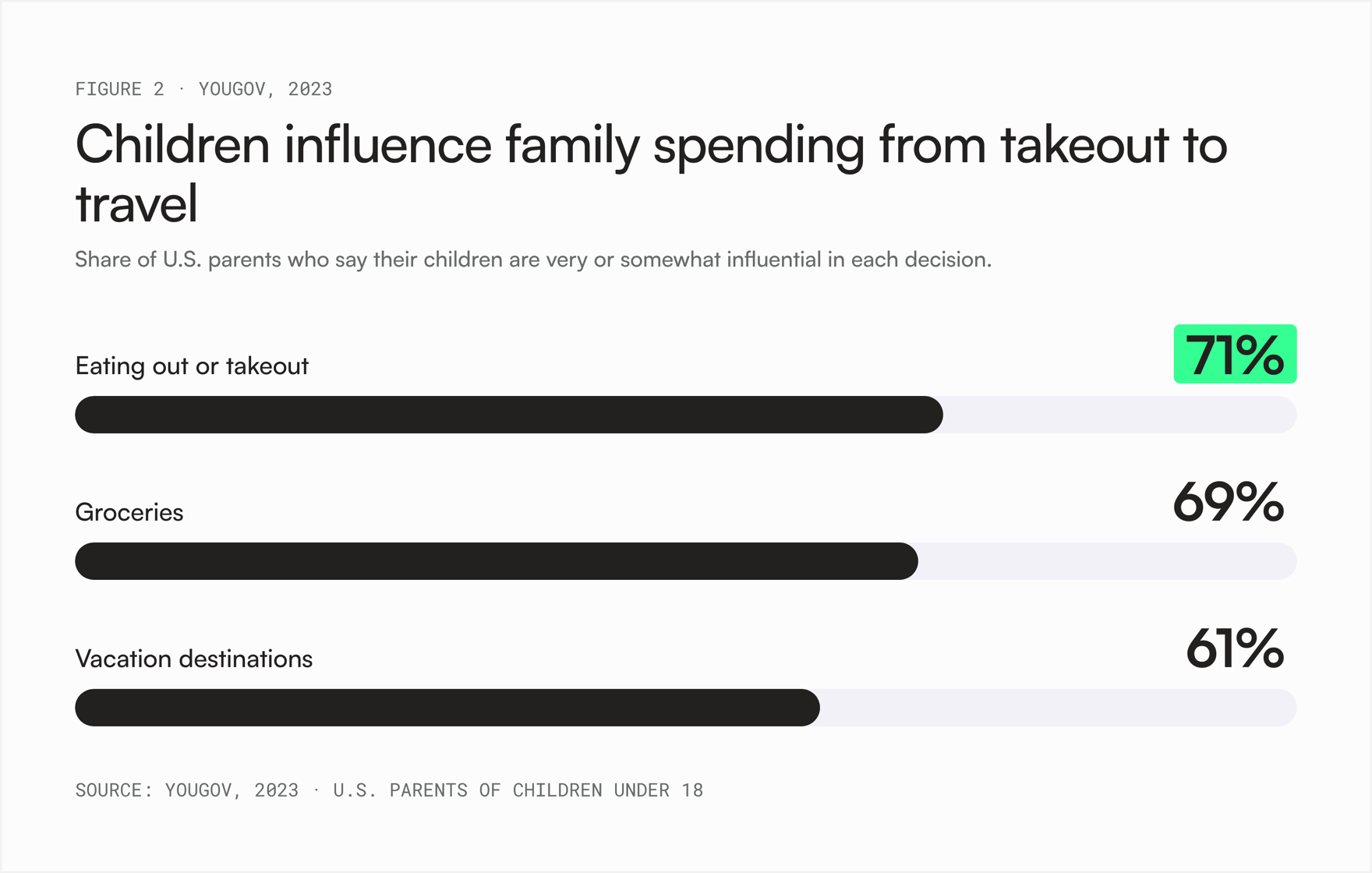
This shows up well beyond products purchased specifically for children. In YouGov’s 2023 research, 71% of U.S. parents with children under 18 said their children influenced where the family ate out or ordered takeout. Grocery choices came in at 69%; vacation destinations at 61%. [4]
Watch What Travels
There’s a longer-term reason to pay attention, too. Youth culture acts as an early warning system for shifts in how the wider market discovers products and decides what’s worth buying.
Some trends stay niche. But the most powerful ones travel, and when they do, they can completely reshape how legacy products are consumed.
In a Publishers Association poll of more than 2,000 people ages 16–25, 59% said BookTok or book influencers had helped them discover a passion for reading [7]. That enthusiasm translated into sales. In 2024 Bloomsbury reported a 161% rise in sales of Sarah J. Maas titles, citing social-media word of mouth alongside promotional campaigns. [8]
A teenager hyping a fantasy novel might feel far removed from your industry, but the underlying behavior isn’t. A young community took an established category, gave people a new reason to care, and brought backlist titles back into the spotlight.
For a publisher, that changes which backlist titles get reprinted. For your business, the question might become: what classic product in your portfolio is waiting to be rediscovered with the right introduction?
Youth culture reaches adult shoppers
The channels associated with youth culture reach far beyond young people.
In NIQ’s 2025 beauty analysis, Millennials and Gen X accounted for the majority of TikTok Shop sales value in the UK beauty sector. [9]
e.l.f. Beauty is a masterclass in this dynamic. In its 2025 proxy statement, e.l.f. reported ranking as teenagers’ favorite cosmetics brand for seven consecutive survey seasons. At the same time, the company captured the number-one spot in purchases among Millennials. [10]
These results show that the platforms and brands built around youth culture are where adult spending is actively migrating.
Their own spending power is growing, too
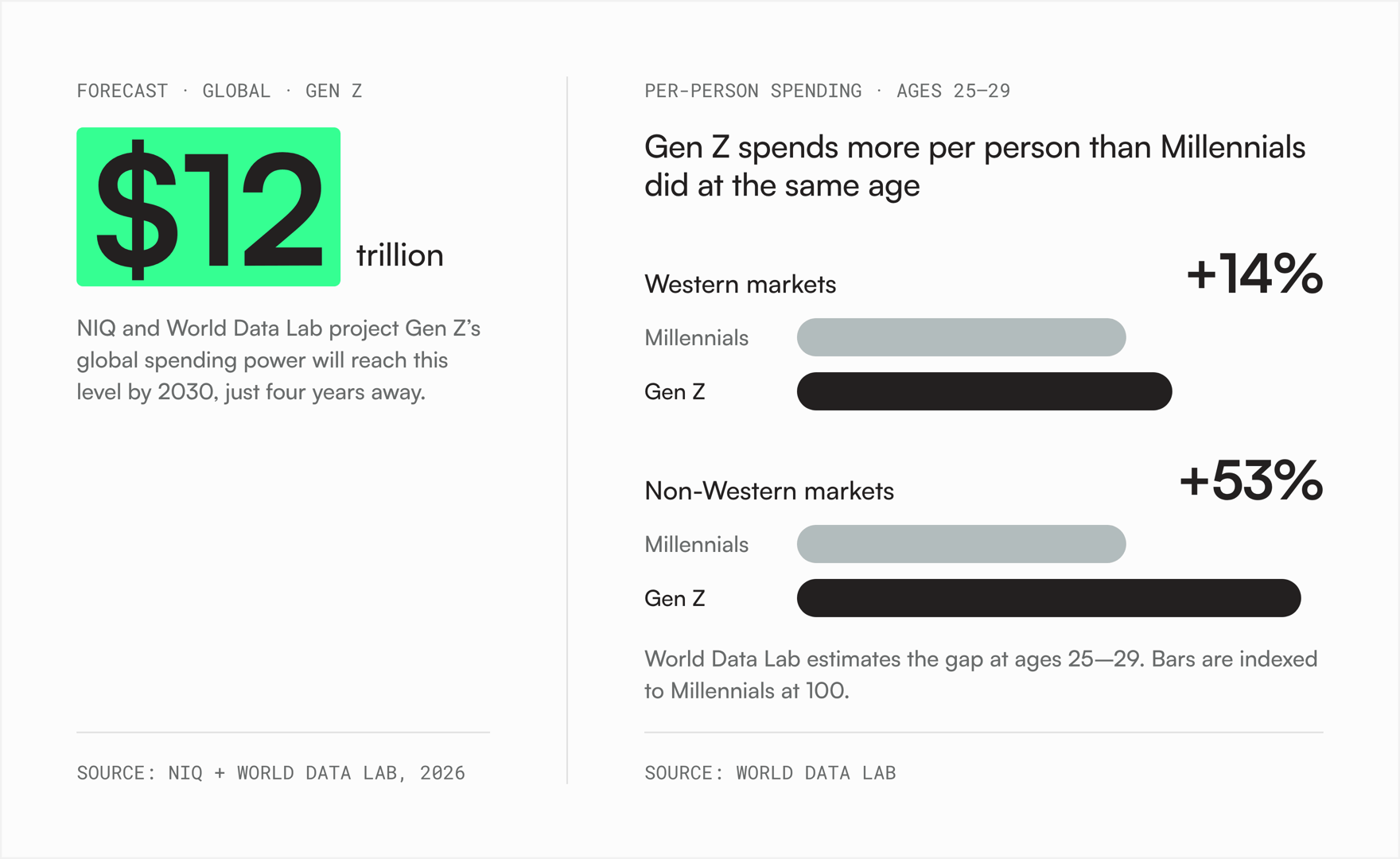
NIQ and World Data Lab project Gen Z’s global spending power will reach $12 trillion by 2030, just four years away. [5]
World Data Lab estimates that, at ages 25–29, Gen Z spends 14% more per person than Millennials did at the same age in Western markets, rising to 53% more in non-Western markets. [6]
Your next customer study could include the younger people influencing the decision. At [cafeteria], we help brands understand what those consumers care about and how their preferences could matter to the customers they serve today.
Sources
1. Edelman, 2023. The Collapse of the Purchase Funnel, report, printed page 13.
2. HarrisX + Allison Worldwide, 2026. Gen Alpha Household Influence Study.
3. PwC, 2026. Gen Alpha Survey Report.
4. YouGov, 2023. Measuring kids’ influence on parents’ purchase decisions.
5. NIQ + World Data Lab, 2026. Gen Z spending forecast, NIQ press release, August 12, 2026; also published on World Data Lab’s Spend Z page.
6. World Data Lab. Generational Spending Data.
7. Publishers Association, 2022. The BookTok Generation.
8. Bloomsbury, 2024. Audited results for the year ended February 29, 2024. Company-reported sales growth of 161% for Sarah J. Maas titles.
9. NIQ, 2025. State of Beauty 2025.
10. e.l.f. Beauty, 2025. 2025 proxy statement, printed page 5.