// [cafeteria]
Gen Z on the 2026 Midterm Elections and the America They Want in 10 Years
Nearly 500 Gen Zers ages 18–26 across the U.S. spent 54 hours talking politics on [cafeteria]. They shared what gets them to the polls (or keeps them home), why working hard isn’t adding up, what they’d tell their senator about AI, and their vision for America a decade from now.
Party of One
Party loyalty isn’t a given for Gen Z. Just 21% feel represented by a political party.
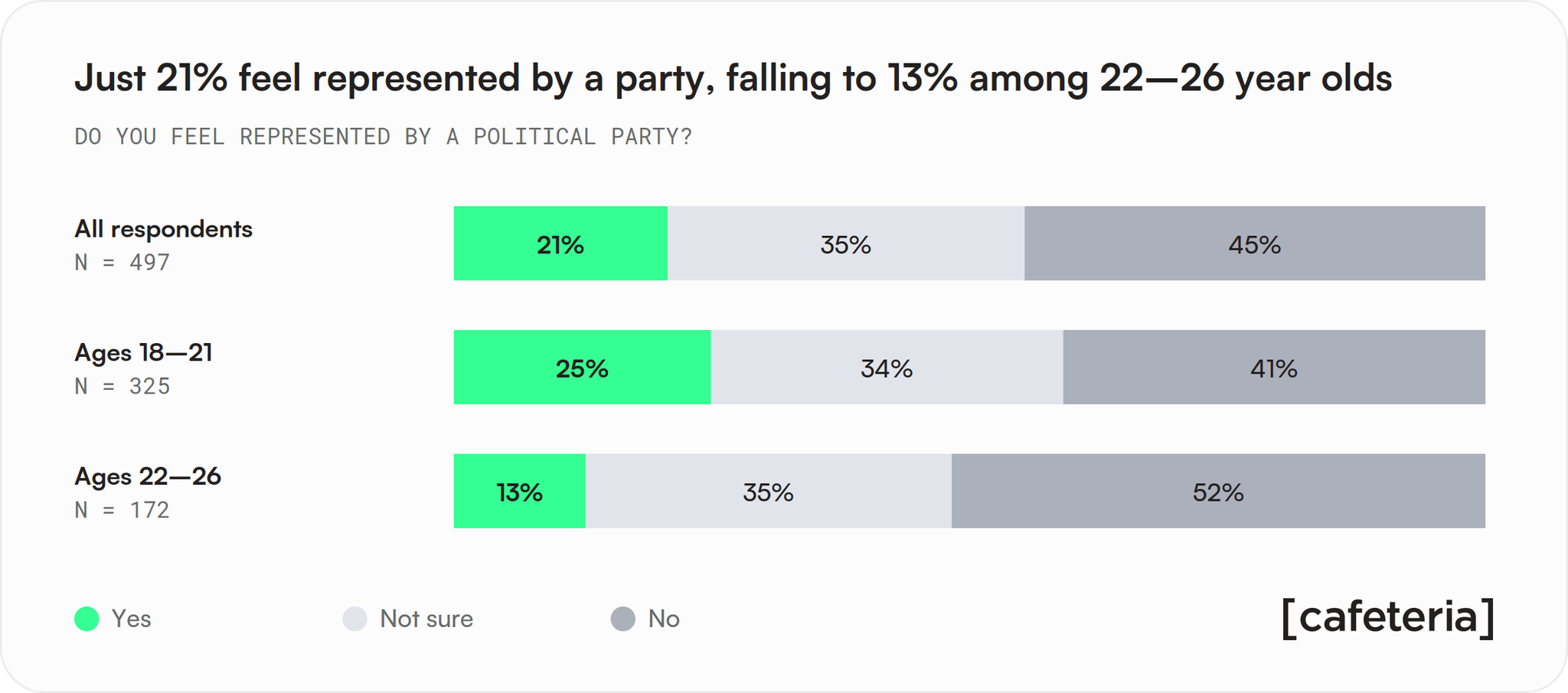
Most don’t see a party that fits.
- Among those who don’t feel represented, the top reasons are that both parties fall short (22%), they agree with each party on some issues but not others (21%), they don’t follow politics closely enough (20%), or parties don’t care about people like them (15%).
No political home, less turnout.
- Fewer than half of those who don’t feel represented expect to vote in the 2026 midterms (43%), compared with 79% of those who do.
Their views are still forming.
- About half (52%) can name a political opinion they’ve flipped on, often moving away from their family’s politics as they got older.
“I’m only not sure because I feel like some political parties understand certain issues, but I don’t think any party fully represents what matters to me and my people, my age.”0:00
“I just don’t. I don’t know. I mean, yeah, I’m probably gonna vote, but once again, I just don’t feel represented by anybody. The choices all suck to me. Nobody actually cares about what I care about, it seems. Or what anyone else that I know cares about. It’s like we’re being ignored and I hate it.”0:00
“I feel like I’m quite in the middle. I don’t follow all the right-wing content, but I also don’t follow all the left-wing content. I’m just kind of politically homeless right now.”0:00
“i use to favor trump when i was younger because my family really liked him but as i grow older and a sense of self i realize how disgusting and horrible he and most other elites are”
“Definitely, even though I’m a Republican, I am pro-choice and I still identify as a Republican because even though I don’t agree with one thing, I agree on like most like other things and I think that there’s more important things out in the world than abortion. And I feel like I have just because when I was younger I used to be pro-life but I didn’t really fully understand how easy it is to like get pregnant and for just people who have been sexually assaulted and like what could happen to them. It’s like there’s just so many you know examples of like things that we need for like abortion.”0:00
The Female Vote
Young women are more likely to believe voting can change their lives.
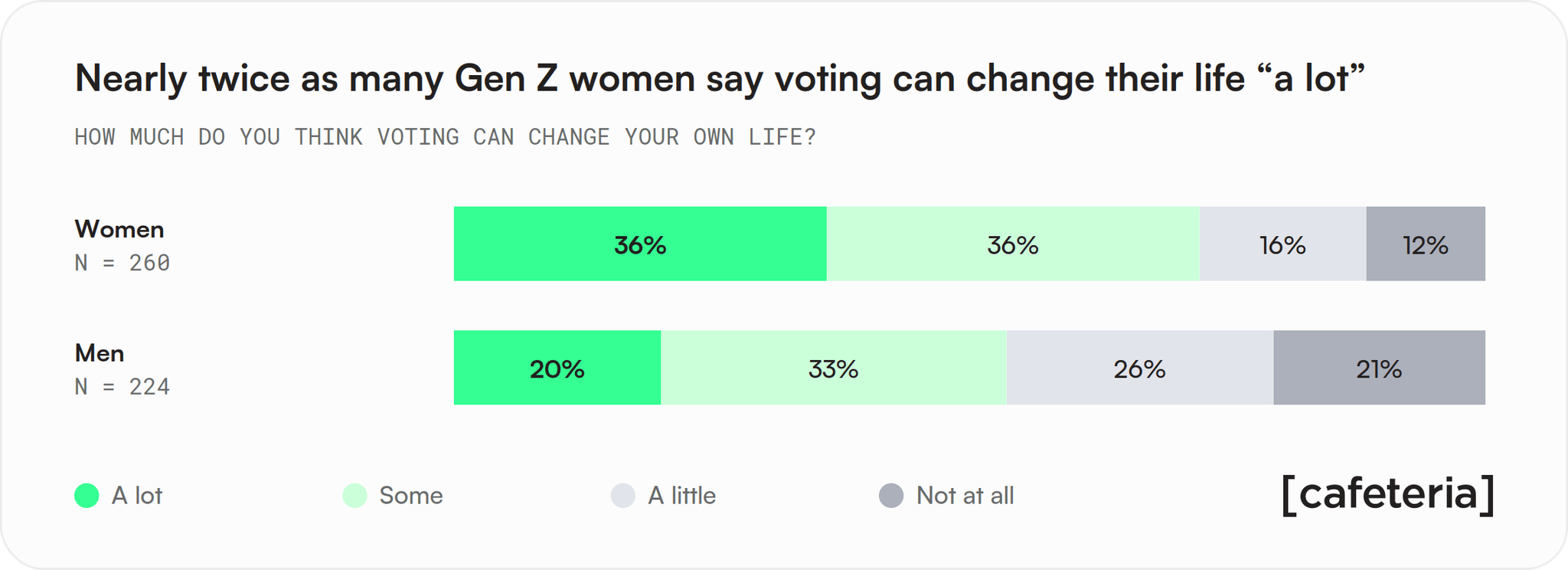
- Women are far more likely to vote. 63% expect to vote in the 2026 midterms, vs 38% of men. Nearly half (49%) say voting is their responsibility, vs 29% of men.
- Men are more skeptical. They’re nearly twice as likely to say voting can’t change their life at all (21% vs 12%).
- Politics weighs on women more. Women more often say they’re frustrated with politics (33% vs 20%) or overwhelmed and tuning out (22% vs 12%). Men more often say they never cared (25% vs 13%).
- For women, it’s personal. 19% say politics got personal when their rights or identity were on the line, vs 8% of men, citing abortion, ICE, race and LGBTQ rights. Twice as many women say healthcare costs are hitting their wallet hard (33% vs 16%).
“Voting is so incredibly important and it’s a civil duty that I take pride in and I would never not vote.”0:00
“Um, because I think that it’s important for my opinion to be out there. I think that having the ability to vote is a right and it’s definitely a privilege and but at the same time I’d only do it if I were educated.”0:00
“If you’re black, politics are always personal and they can’t just not be background noise. I lived in the Flint water crisis, that was political. My dad, he’s a civil rights worker, that’s political. Like my entire life is political. You can’t just bury your head in the sand.”0:00
“It started feeling personal to me when I became an adult and also just seeing like people of color’s families being ripped apart and I just don’t agree with it and I’m an adult so I have a choice to vote.”0:00
“the 2016 elections / that was when i realized that my rights weren’t a guarantee and that the results of the election would have a major consequence in my life”
Read Up, Then Show Up
Gen Z asks: Why would I cast a ballot if I haven’t done my homework?
Not knowing enough is a real barrier. Among Gen Z unlikely to vote in the 2026 midterms, the second most common reason, after not being into politics, is feeling they don’t know enough to make an informed choice (20%). They worry about voting for the wrong person or want to research the candidates first.
A subset turn to AI for research. 15% have used AI to look up political information. Most often, they use it to compare candidates, get issues explained, or check how to vote and what’s on their ballot.
“I’m probably not going to vote because I’m still learning about politics and don’t feel fully informed about the candidates or the issues yet. I want to understand more before making a decision that could affect my future.”0:00
“I don’t want to vote if I’m not sure about who I’m voting for, so if I’m well-researched, then I probably will.”0:00
“After looking up my own information, I put it into an AI and asked it to create a spreadsheet. I think my columns were Pro, Con, Scandal, Education, Abortion, and one other thing I don’t really remember.”0:00
“I literally know nothing about the midterms so I would be doing everyone a disservice.”
Hard Work, Hardly Enough
The promise that hard work pays off is wearing thin with Gen Z.
- Effort no longer adds up. About 1 in 6 (17%) describe working hard and still falling behind: a job market that feels nearly impossible to break into, wages that haven’t kept pace with prices, or long hours just to cover the basics.
- They reject the “lazy” label. “Lazy” is the stereotype they most often say older generations get wrong about them (26%). Many push back by pointing to the economy: long job searches, juggling more than one job, and paychecks that don’t cover the basics.
- Everyday costs are the squeeze. 60% say groceries are hitting their wallets hard, followed by transportation (48%), rent (40%) and student loans (37%).
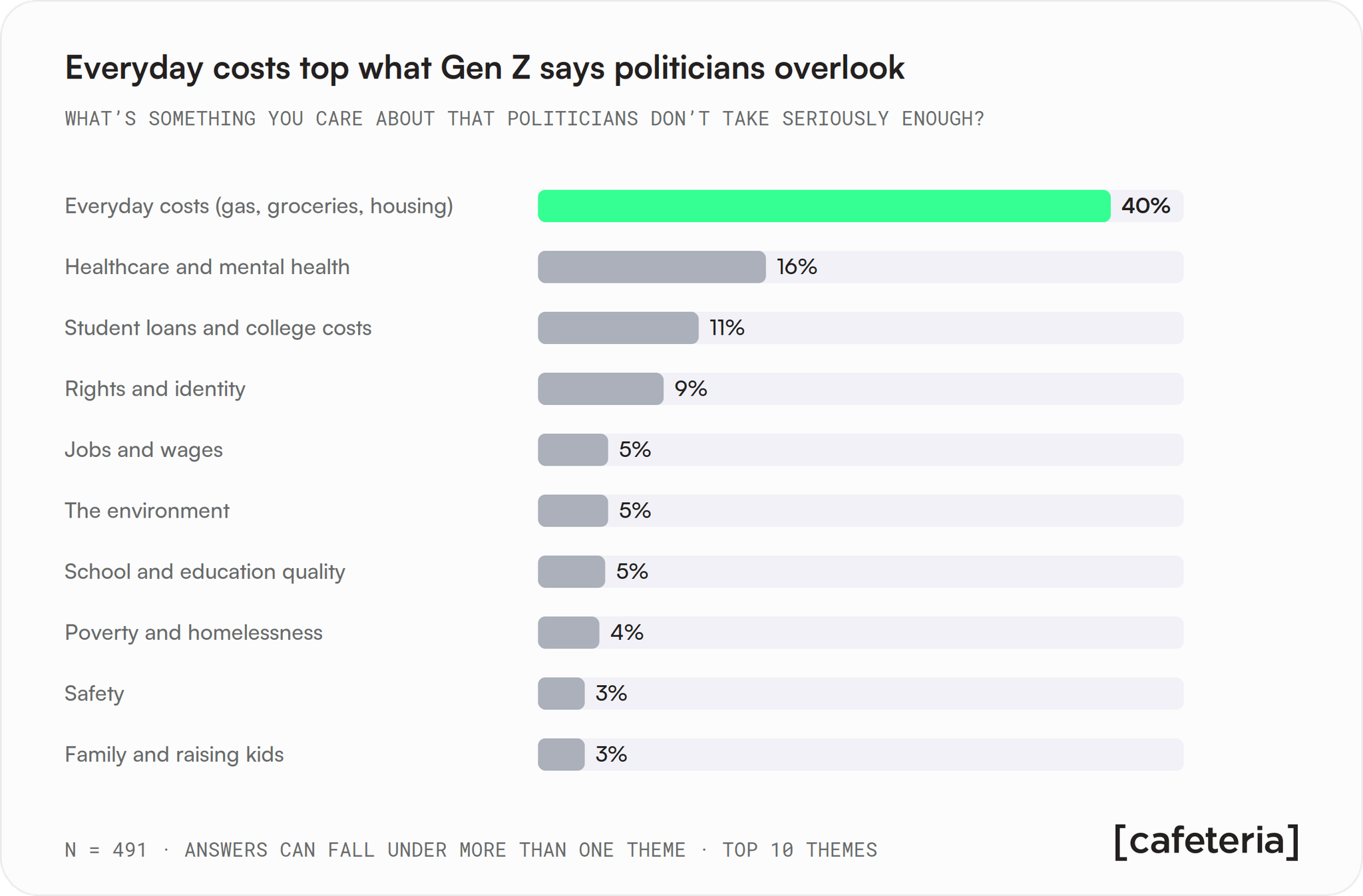
- No issue comes up more than cost of living. It’s the top thing they say politicians don’t take seriously enough (40%), the top thing they want politicians to focus on (35%), and the top promise that would win their vote (42%).
“The main thing that older generations get wrong about people my age is us not wanting to work. We actually want to work and, you know, because considering we’re applying for a thousand and one jobs per day, per week, per year at this point. Um, it’s not that we don’t want to work. It’s that the job market is ass and has been for a good couple years because of the insane number of us that are still going to college. Because the older generation made us decide that college was the run true path for us.”0:00
“I really think politicians should focus on making the cost of living as affordable as possible and making sure the gap between rent paid and the money you make from working a minimum wage job should be closed.”0:00
“I’m sure trump has never pumped a car with gas”
“They obviously don’t take minimum wage seriously. Like how can the price of everything rise but not the minimum wage? How do you expect people to be able to afford even a home if they’re getting paid the same amount from the 1970s? But everything costs like it’s 2006.”0:00
“If someone promised to fix healthcare and the pricing of housing, then they’d have my vote because I want a house and I can’t afford it for 10 years.”0:00
Back In Your Day
More than half of Gen Z think life at 30 will be harder for them than it was for their parents.
The closer they get to 30, the harder it looks. 60% of 22–26 year olds say their parents had it easier, vs 48% of 18–21 year olds.
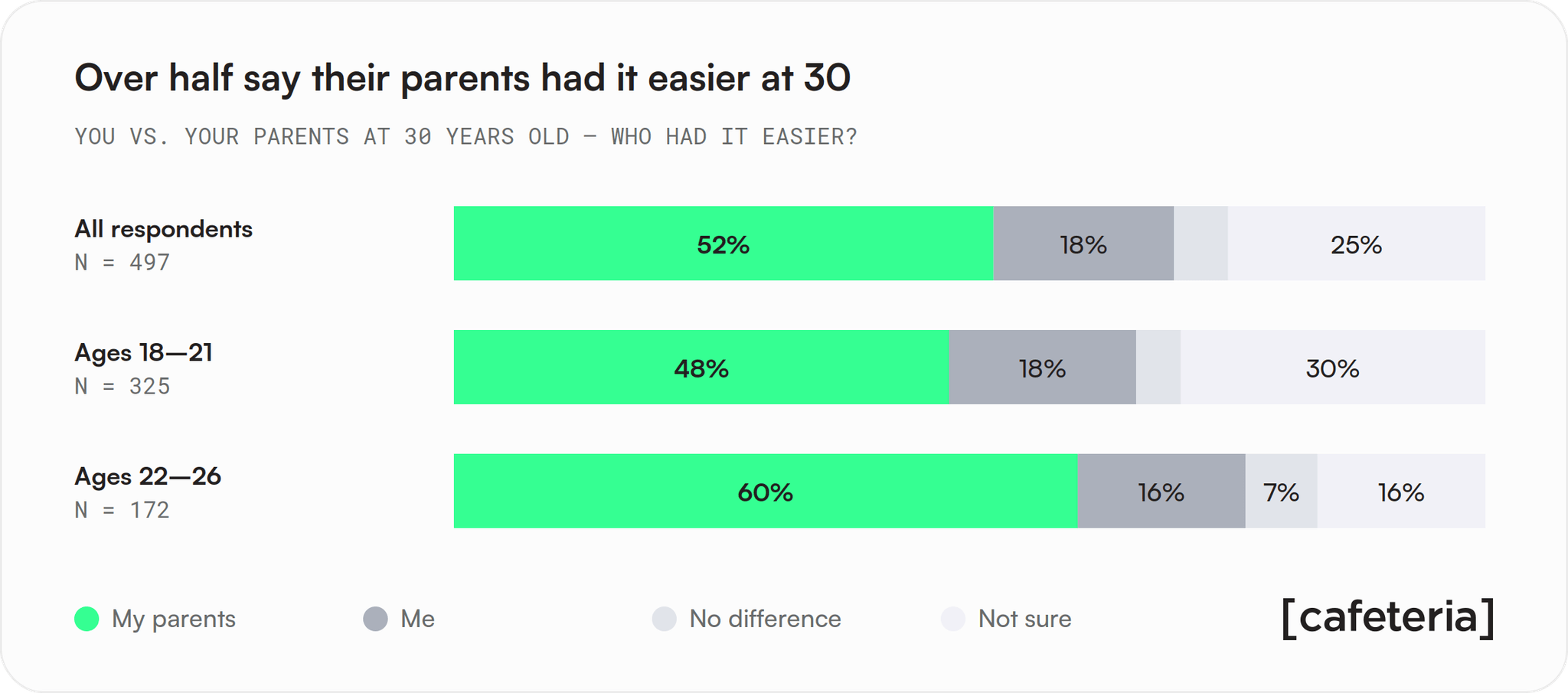
- Their money went further. About half of those who say their parents had it easier point to lower prices (48%). Underneath is a sense that pay and jobs used to keep pace with costs.
- Milestones arrived on time. Some describe a home, kids and a stable career by 30, things that now feel out of reach.
- A calmer world. One in five point to a calmer time: less political division, no social media, less technology and AI, and more stability. For two-thirds of them, that’s the whole reason, with no mention of cost.
“My parents had a much easier economy. Honestly they grew up way poorer than I was. My dad didn’t have a college education. My mom was a schoolteacher and they both were able to buy a home, buy 30 and have two children and my brother is pushing 30 and cannot find a house anywhere that’s affordable and will be like a good investment.”0:00
“they weren’t dealing with insane rent and house prices, getting a job after graduating college wasn’t impossible, they weren’t addicted to their phones”
“It was a lot simpler to be able to get an apartment and kind of like fend for yourself, but now it’s like a lot harder. There’s so many kids and younger adults that have to live at home with their parents because they can’t afford to be with themselves, be by themselves, sorry.”0:00
“it wasn’t as angry and divided, people could be respectful”
Senator, Let’s Talk AI
AI is moving fast. Gen Z wants lawmakers to rein it in.
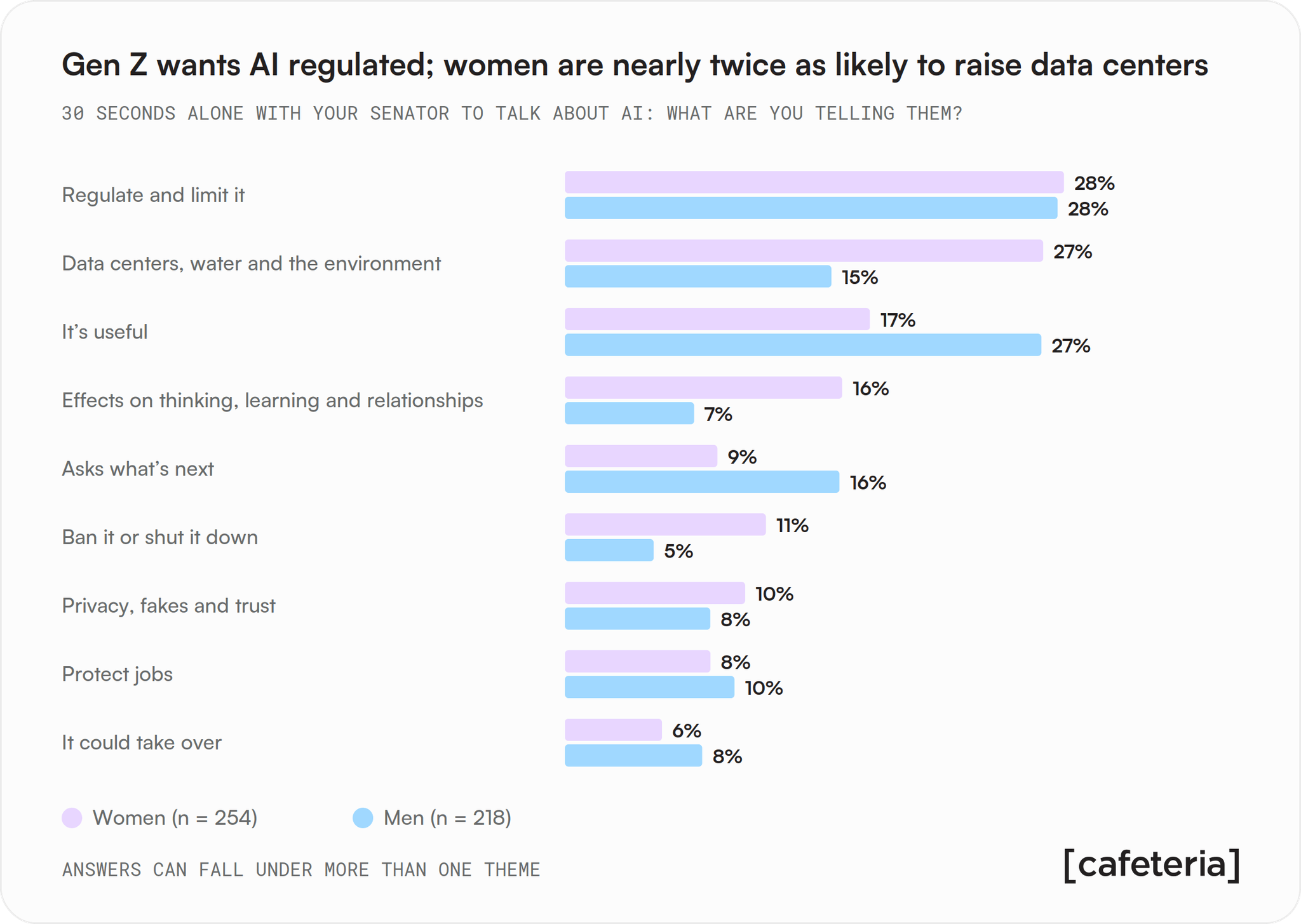
Asked what they’d tell their senator about AI, Gen Z’s top message is to regulate and limit it (28%), followed by data centers and their toll on water and the environment.
Most messages are warnings. Half are negative about AI (51%), just 13% are positive and 26% are torn. Women are more negative than men (58% vs 41%).
Women bring up data centers more often than men (27% vs 15%), and water is the harm they name most.
Some suggest a better way to build. Rather than banning data centers outright, some suggest building on land that’s already developed or setting rules about where they can go.
“I’m telling them that although it has its good uses, it should not be as widely used by every single member of the population because of its climate impacts and the fact that people are losing the ability to think for themselves.”0:00
“Please do not think about supporting AI in education. Do not build data centers. AI is not necessary for a lot of things and it’s you should be cut down significantly and controlled so people aren’t losing their jobs.”0:00
“Some kind of regulations have to be put on this. They are making porn of people who don’t know about it, and not only people of age, but children as well. AI is encouraging people to kill themselves, and is basically helping induce different kinds of psychosis, and is not taking over, but people are using it for actual medical advice. And it’s just not safe.”0:00
“I’m asking why are they trying to plant data centers in small towns, and why not just put them on land that nobody would use, or government-owned land?”0:00
“They should find a way to make it like other countries where it’s renewable and it’s not as costly and it’s not affecting the planet but the current systems that we have are affecting so many people, livestock farming and households that it’s not productive to have.”0:00
Our Turn
Gen Z imagines what America could look like in 10 years with their generation in charge.
- A country people can afford. Lower rent, paychecks that cover the basics, cheaper groceries and gas, universal healthcare and free public transportation.
- Honest, accountable government. Less corruption, and politicians who follow through on what they promise.
- Leaders who listen and act. They want leaders who listen to people their age, argue less and get more done.
- A planet and technology they can trust. A cleaner environment and renewable energy, with AI used carefully rather than everywhere.
- A kinder, more equal country. More equality and less racism, with women, minorities, LGBTQ people and immigrants treated fairly.
- A calmer place. Less division and hate, civil debates, more bipartisanship and fewer wars. The calm they say their parents had is the one they want to build.
“I would say they’re not waging wars on everybody. They’re not going against countries that they have treaties with. And they’re actually listening to the people and not just thinking about themselves and their friends.”0:00
“I think we would be in a lot more emotionally intelligent time. I think people would have their needs met and people would be heard by their local politician and government politician, or federal government politician. I think really emotional intelligence.”0:00
“We’re not going to have old people in the government first of all, and we’re going to bring some change in. It’s not going to be all the old traditional ways. We’re going to keep the original values of the United States and the original traditions, but update them.”0:00
“hopefully we can learn from the mistakes we have lived through for a more peaceful and unified country”
Methodology
Findings are based on 497 Gen Zers ages 18–26 across the U.S. who responded on [cafeteria] between October 20 and 31, 2026, ahead of the midterm elections. Gender: 52% female, 45% male, 3% non-binary. Age: 65% aged 18–21, 35% aged 22–26.
This is not a poll or a forecast. The sample is not weighted to the voting population, and expected-turnout figures reflect what respondents said they plan to do, not a prediction of the election. Voting-intention figures exclude the 27 respondents who said they aren’t eligible to vote (n = 470).
Most questions were open-ended. Alongside a few multiple-choice questions, such as whether they feel represented by a political party, respondents answered in their own words. Themes like “regulate AI” or “both parties fall short” were not shown as options; they surfaced from what people chose to say. Open-ended answers can fall under more than one theme, so percentages may add up to more than 100%.
How [cafeteria] works. [cafeteria] is the largest private network of Gen Z and Gen Alpha consumers, built from millions of direct conversations about the brands, products, cultural moments and ideas shaping their lives. These happen in the [cafeteria] app as private, one-on-one exchanges. Members respond by text or voice note to open-ended questions, and are paid for their time and insights.
How we analyze. Responses are analyzed through [cafeteria]’s proprietary technology and by analysts and cultural strategists on our team. Every open-ended answer was read and coded into themes, and responses were screened for quality before analysis. Voice notes were transcribed with Whisper AI, and quotes appear as spoken.
A note on denominators. Most percentages are based on the full sample, but some count only the relevant group, such as those who don’t feel represented or those who say their parents had it easier. Bases are shown in each data visualization. Gender and age differences called out in this report are statistically significant at the 95% confidence level.