// [cafeteria]
Gen Next Talks Health & Wellness in 2026
1400+ Gen Z & Gen Alpha spent 237+ hours talking health and wellness on [cafeteria] — enough time to walk 1.2 million steps.
They shared how they're spending on wellness, the creators they trust, wearables, where they stand on GLP-1s, and how AI is (and isn't) a part of their health.
The Wellness Wallet
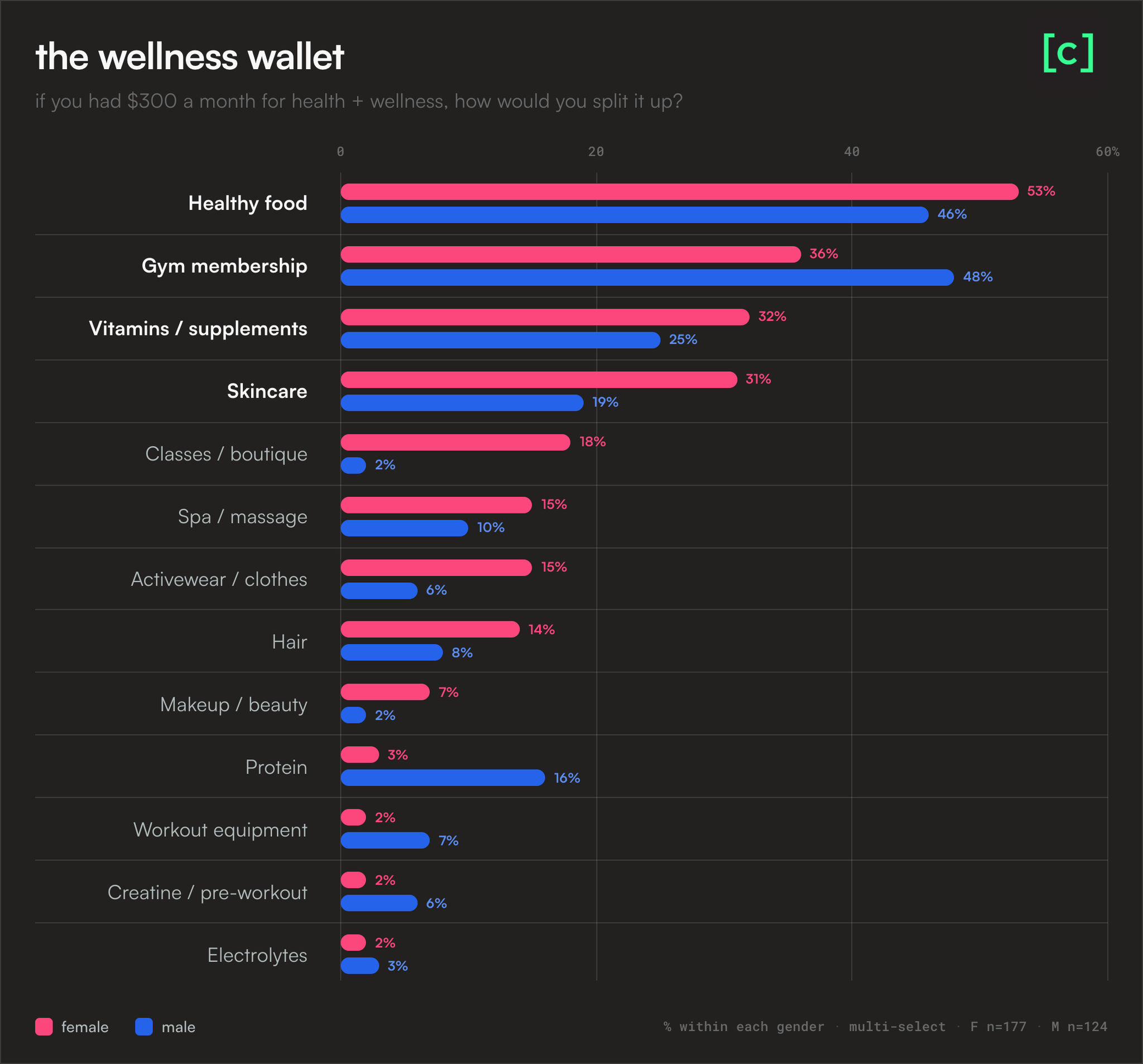
When asked how they’d spend a $300 budget on health + wellness, Gen Next revealed the categories they value most.
The core purchases: healthy food, gym memberships, vitamins + supplements, and skincare.
- Females also spend across athleisure, beauty, hair, and boutique classes like Pilates and cycling.
- Males’ remaining dollars go to performance fuel and gear: protein, creatine, electrolytes and workout equipment.
“I’d probably split it up between Pilates classes and trying out new workout classes like cycling. And I would also spend it on really high quality organic foods that I can cook good meals with.”0:00
“I’d probably spend more on the gym, get a membership somewhere that costs like 70 bucks. Rest is all creatine and protein.”0:00
“Maybe $50 on supplements or energy drinks or like creatine if I want to try. $150 on like skincare, haircare, and then the last $100 on like hair removal.”0:00
“Um, I guess like $10 on soap, $5 on toothpaste, $50 on supplements maybe, because I can start improving, what do you call it, protein powder and stuff, maybe $75, you know, if there’s another one out there worth taking, including creatine in there as well. I guess I’d start doing skin care again, which is probably close to $50 a month, something like that, and then, hmm, that’s most of what I can think of.”0:00
Top Wellness Brands
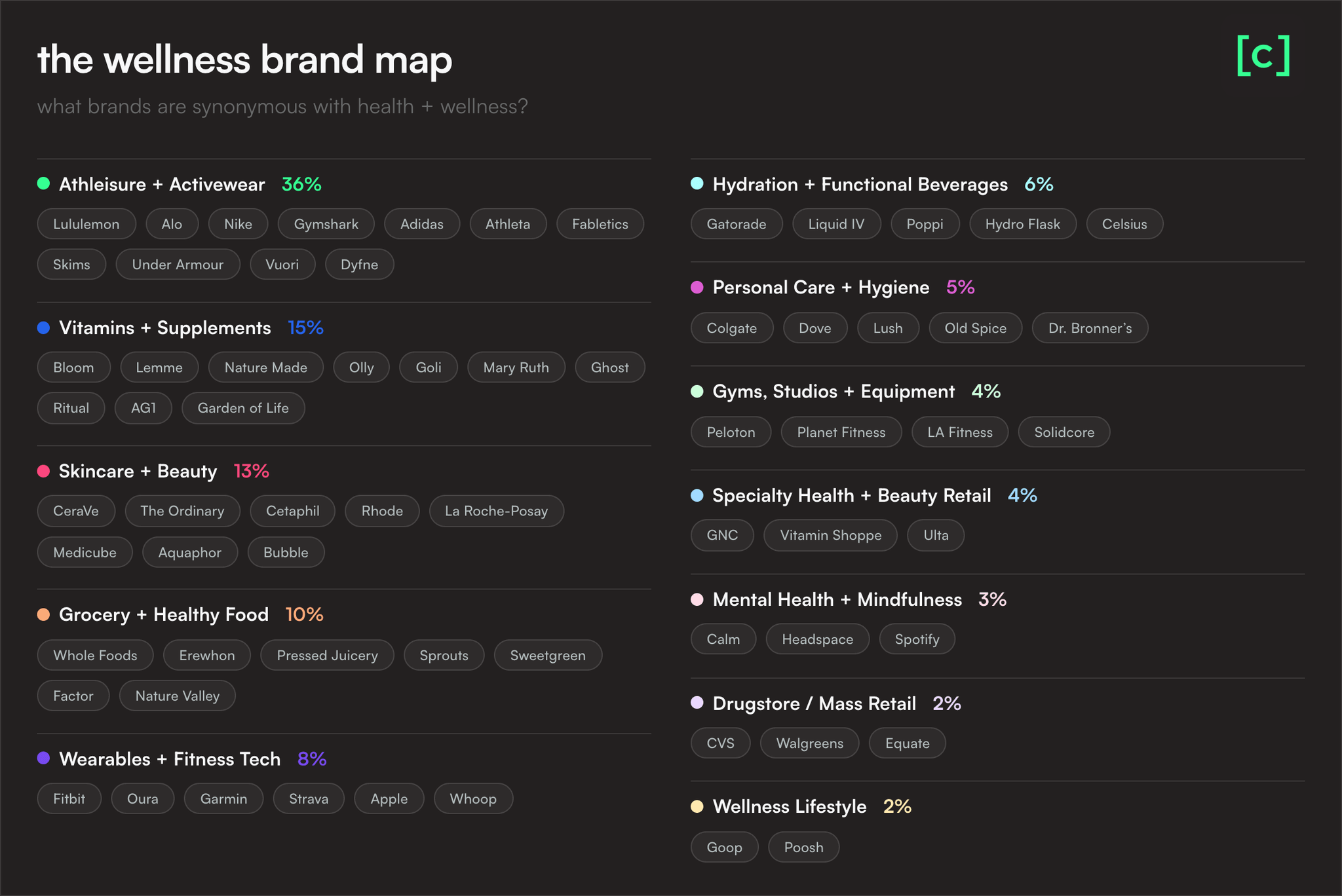
Athleisure isn’t just a wellness purchase. It’s how Gen Next defines the category.
When asked what brands are synonymous with health & wellness, athleisure makes up 36% of all brand mentions.
Top named brands across all categories were: Lululemon, Alo, Nike, CeraVe, and Whole Foods.
Face, Valued
Gen Z + Alpha use their skin as an indicator of their overall health.
When asked for the most noticeable difference between when they are taking care of themselves versus when they are not:
- 1 in 4 females and non-binary respondents name skin as the body’s most visible feedback loop.
- 15% of males also name skin as a diagnostic of overall health.
Good habits (sleep, diet, hydration, stress) register as a glow; bad habits show up as breakouts.
- Some also mention a vicious cycle: if they’re not feeling well, they skip their usual skincare routine, which leads to worsening skin outcomes.
“The most noticeable difference, when I’m taking care of myself or not, is probably my skin. You can tell if I’ve been eating good or how my health is based on how dull my skin looks, I guess. Or if I’m getting acne, then I know I’m not eating good.”0:00
“When I’m not taking care of myself my face breaks out. I don’t normally have acne, but when I’m not taking care of myself my face always breaks out, and also I feel incredibly lethargic all the time.”0:00
“The most noticeable difference is probably my skincare. When I take care of myself, I do my skincare, and then I don’t break out.”0:00
Glow for Her, Gains For Him
Females treat red light therapy as skincare. Males treat it as recovery tech.
62% of females are into red light therapy vs. 42% of males.
- Females’ #1 reason is to improve skin (37% vs 26% of males). Acne is the present-tense hook and the anti-aging future bet.
- Males are 2x more likely to frame it as recovery (18% vs. 7%), and uniquely flag hair regrowth (7%) as a key benefit.
Barriers to adoption look different across genders.
- 10% of females doubt it works. They’ve heard of it, weighed it, and written it off as ineffective or hype.
- 14% of males simply don’t know what it is. Some conflate red light with UV and cite cancer concerns.
“Love it. Great. Everyone does it. Literally everybody that I know does it. I’ve seen benefits to my skin from it and 10 out of 10, 100% recommend. Very into it.”0:00
“I’m interested in this because I see a lot of people online, whether it’s ordinary people or celebrities, and they really talk about the benefits of red light therapy and how it can help reduce wrinkles and clear your skin, but also help with hair growth and just make your skin ultimately more healthier.”0:00
“im into it because it safe non-invasive and the process boosts cellular energy, promoting natural healing, reducing inflammation, and increasing collagen production.”
“first of all it’s creepy, second of all it’s too much like one of those scam LA health nut things. like I’m supposed to have a huge red light bed in my apartment or buy a $100+ mask?? they don’t have that in the blue zones and they’re doing just fine.”
The Self-Tracking Generation
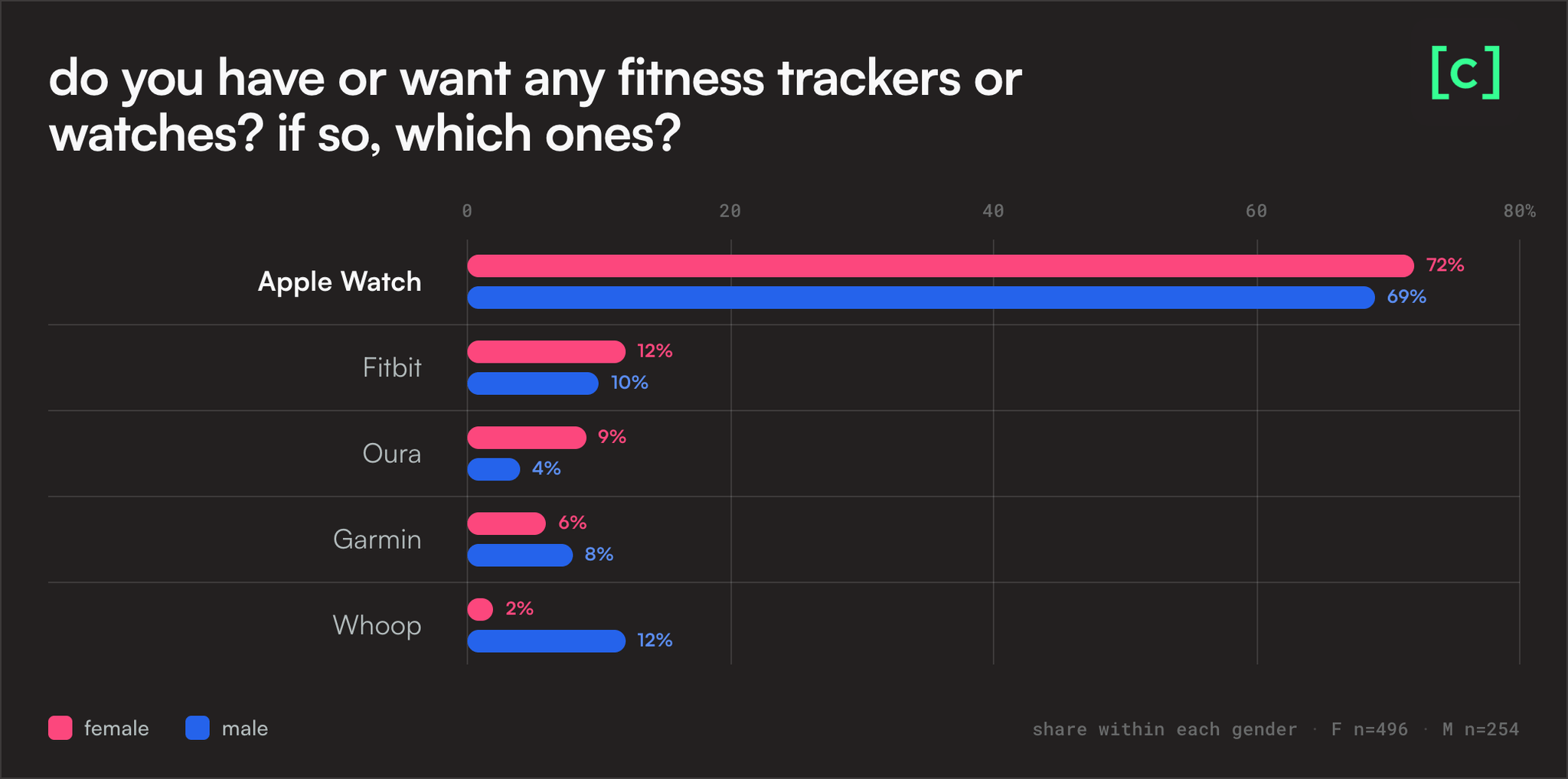
Over 57% of Gen Next has a wearable on their wrist or on their wishlist.
- Apple Watch is the leader. The all-in-one that comes integrated into your life.
- Oura wins on aesthetics. It passes as jewelry, not tech. Skews female.
- Whoop is the most performance-coded: recovery, training load, sleep score. Skews male.
- Garmin is the serious runner’s watch. Advanced metrics and longer battery life than Apple.
- Fitbit is the gateway wearable: the first tracker for many due to the accessible price-point.
“I have the Garmin Forerunner 265 like fitness watch and I use it for running but I also use it like to track my sleep and my heart rate and my steps and my calories and yeah I feel like it’s really helpful when I’m looking at like health stuff.”0:00
“My personal favorite is called the Whoop, W-H-O-O-P. I don’t have one personally but all my friends have it and they love it. I’m planning on investing in one in 2026. Very good reviews.”0:00
“I used to have an Apple Watch, but it broke. I’d really like an Oura Ring because it tracks your overall health rather than specifically just workouts.”0:00
“ive been looking into getting a fitbit recently, apple watches are just way too overpriced to justify it for me”
Tracking: The Sleeper Metric
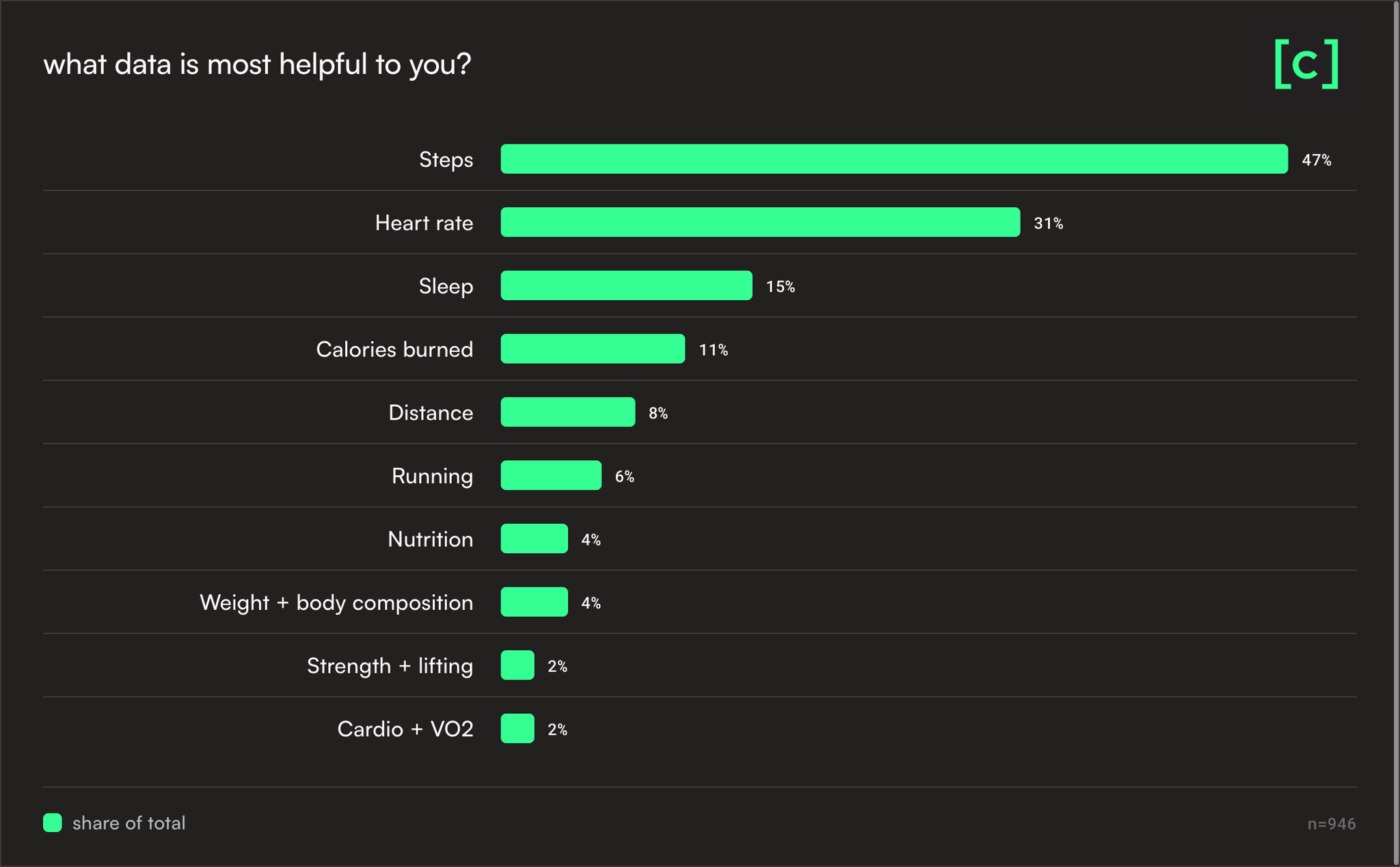
When it comes to data, steps and heart rate are the most tracked by Gen Next. 1 in 7 also name sleep.
How Gen Z + Alpha interpret sleep data:
- Quality and quantity, not just hours. They want how well they slept (score, patterns, consistency) alongside how long.
- It explains how they feel. The data helps make sense of their energy, mood, and aches.
- It sets the dial. The data gives permission to slow down or the green light to train harder.
“Definitely like how long I spend like recovering and sleeping because it like it tells me like like what like reasons like why I’m like tired or like why something’s like why something like hurts or like sore I think oh I didn’t get enough sleep”0:00
“sleep data is super helpful, not just about length but also about quality. it helps me understand better why I’m feeling certain ways and when I can exert myself more.”
“I think data that’s most helpful to me is data specifically around women and working on physical activity. I feel like a lot of the gym advice out there, and just in general physical activity, a lot of the advice and data is catered towards men, and so I would like to see a lot more that’s catered towards women because we have biological differences, hormonal differences, we have a different cycle, and I feel like that would be extremely helpful for me.”0:00
“The most helpful data to me would be things that actually impact performance and recovery like sleep quality, recovery levels, and overall strain rather than just basic stuff like steps or calories, because I train a lot and what really matters is how well my body is recovering and whether I’m ready to push hard again, so things like heart rate variability, resting heart rate, and sleep consistency would be the most useful since they give a better picture of how my body is adapting over time, and I’d use that more to adjust intensity and avoid overtraining rather than obsessing over numbers, just using it as a way to stay consistent and optimize performance.”
“really just like the data for I think all the data is really helpful but I feel like the data that’s all about like your sleep is so interesting because I always I’ve never been the person to have the best be sleeping the best like some nights I fall asleep super easily sometimes it takes hours me to fall asleep it just really depends I think I would love to learn more about that stuff”0:00
GLP-1s: Earned, Not Injected
Gen Next overwhelmingly passes on GLP-1s – 72% say no. And the core objections aren’t only about safety.
- Among those not interested in GLP-1’s, 28% want to lose weight without intervention. Some mention that taking the drugs has a trade-off: once you stop, the weight comes back.
- Side effects are cited by 25%, several naming bone density unprompted.
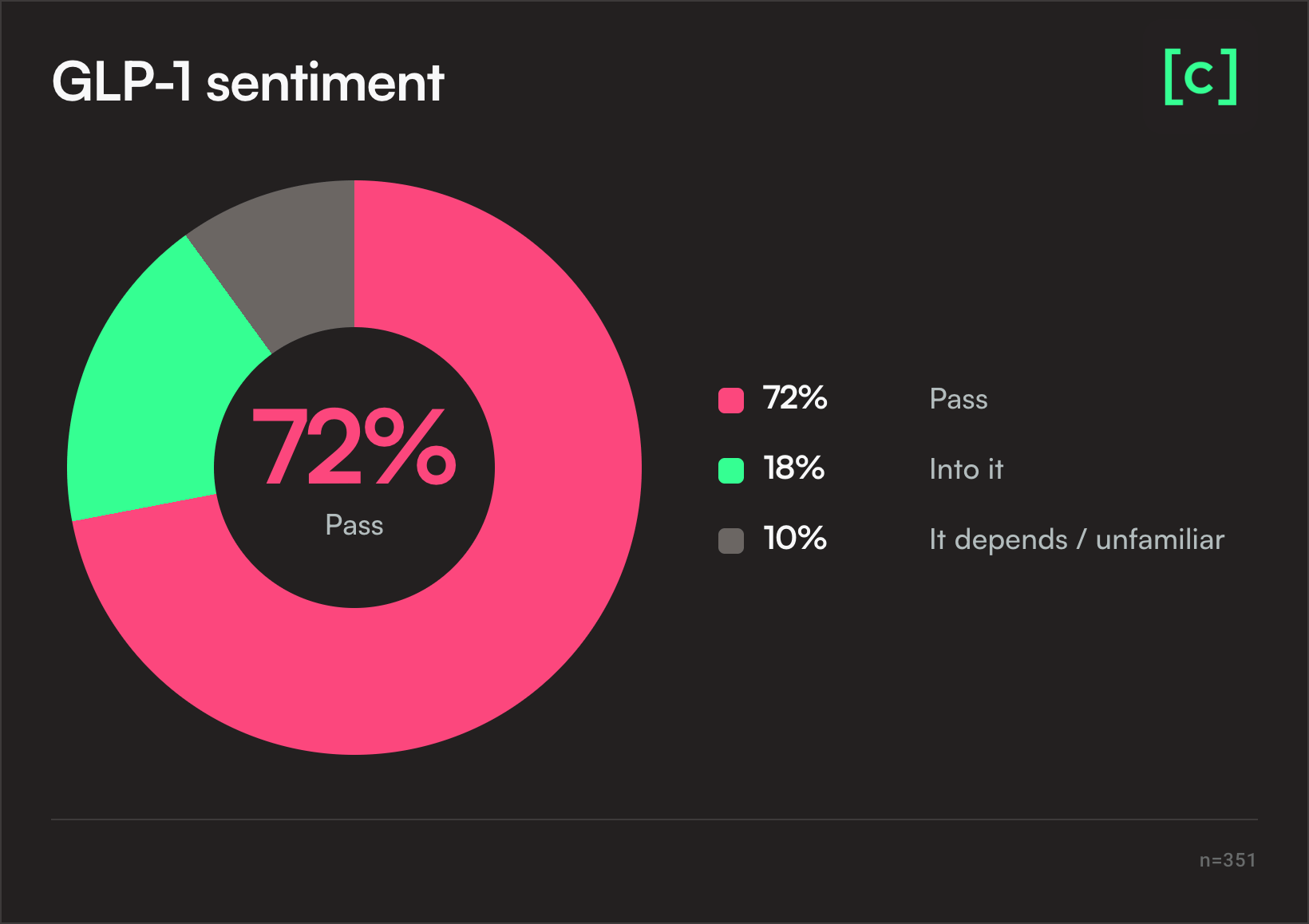
Even the 18% who are pro almost always qualify it. The line turns on two tests, and both have to clear: a real medical need and a doctor’s sign-off.
- Into it for: diabetics, the severely obese, cases where nothing else has worked.
- Not into it for: the casual user, the cosmetic crowd.
Objections that skew female include:
- A medicine with a victim. 8% of the females who passed frame GLP-1s as diabetes medicine borrowed by people who don’t need it. A smaller, vocal group points to the shortages and price hikes it creates for the people who do need it.
- The Y2K revival no one asked for. Some see GLP-1s as a beauty trend dressed as medicine: one that normalizes eating disorders and revives the celebrity-fueled skinny epidemic of the 2000s.
- A fear of “Ozempic face.” They describe a visibly deteriorating body: sickly, skeletal, withering.
“I’m extremely nervous about the potential harmful effects of using Ozempic and GLP-1. I don’t know, like the change in bone density or whatever. And I don’t want to become dependent on a weight loss drug to lose weight because it seems too much like a crutch and unsustainable for the long run.”0:00
“Big no from me. I think it’s really dangerous, and it’s literally started the skinny 2000s epidemic, which is so dangerous to young girls, and I think all the celebrities getting skinny on it, it’s just such a bad example, and it’s a recession indicator… once you go off it everything comes back… I just worry about the implications on our society that people are using drugs to look like skeletons.”
“A very few people actually really like should be using it that I can’t actually lose weight in a natural way so but it’s just a cheat you’re not actually earning anything by that.”0:00
“I’m into it if it’s being used in the way that it’s scientifically and medically designed to be used.”0:00
“I do not believe in using medication that’s made for diabetic patients for cosmetic reasons. I don’t think it’s safe nor do I think it’s morally correct. I don’t like that at all. I don’t like that idea, not one bit.”0:00
Peptides: A Shot In the Dark
Gen Next females reject peptide injections. Some males are curious.
85% of females are against them. They negatively associate the injections with frat-boy steroid users and looksmaxxers.
66% of males are against peptide injections. Even those who find them promising want more research or proof they’re safe before buying in.
Across genders, the core objection is the same: self-injecting a mystery substance bought off the grey market, no doctor in sight. Some also smell a hype cycle – an internet trend pushed by influencers.
“peptides are great, even the experimental ones. you have to be careful because many are still under research but they’re very promising and there are so many of them you can really personalize your regimen to exactly what you’re looking for.”
“Because they’re not good for you, and they’re very scammy, many influencers use them and try to promote their own brands, and their own non-FDA approved nonsense, and it’s just, maybe if you get it from the right people it’s good, but I don’t know, I don’t think it’s good.”0:00
“The only people that I’ve like even heard talk about peptides are frat boys and anything that a frat boy puts in their body I don’t want to put into my body”0:00
“Why are we injecting random stuff into ourselves? Like, I’m sure peptides, you know, some people have basic understandings and there are people who have been doing peptides but we shouldn’t just be, you know, like getting them off the black market or getting them off websites that shouldn’t be selling them and just injecting them into ourselves without really knowing what it is. Like I said, I can see if you really need these things but most of the time I see it’s people who are doing them. They just want them for a desired look and honestly with the calorie deficit and more active, you know, behavior as long as it’s not like a hormone thing, you can get the results you look like you want to look like without poking yourself every day.”0:00
“Controversial, but I’m into it. Me personally, I wouldn’t do it myself even though peptides are still considered natural. I don’t consider natural for myself. If you’re injecting something to help you get an easier path to losing weight or getting muscle, then I don’t consider it, but I am into it. I think RETA, for example, helps you lose weight while still being able to put on muscle. I think it’s really healthy. There still needs to be more research done. I’m not sure what the complete long-term side effects are, but from what I see from friends’ social media, I think it’s a pretty good positive and I’m pretty into it. I know another peptide, GHK, is pretty good. It’s like a topical for your skin. I heard that it has some good benefits and there’s many more like the ones that help with joint pain, etc, etc. Overall, I think they’re pretty beneficial.”0:00
Proof Over Promises
Gen Z + Alpha treat every product claim as guilty until proven innocent.
What earns trust:
- Proof is the biggest lever for nearly 1 in 5. Research, clinical evidence, third-party testing, real numbers they can check.
- Reviews are the trust currency (15%). Third-party reviews, not the brand’s own site, that show both pros and cons. The bad review is the tell: if they can’t find one, the product’s “too perfect.”
- Restraint and transparency. Claims that stay in one lane, name the actual ingredient, and don’t over-promise.
What reads as a scam:
- Anything that smells paid. Nearly a third of females flag sponsorship, affiliate links, and coupon codes (2x the male rate).
- Whole categories are pre-judged. Gummies, weight-loss powders, “fat-burning” supplements are read as scams until proven otherwise.
- AI in the ad. AI voices, images, even AI-sounding copy trigger an instant flag.
“It’s hard because my brain defaults to scam just because I’m really, I don’t want to get scammed. Even if a lot of people are promoting, for example, like the Medicube, almost all the Medicube products to be honest, but the Booster Pro. They got Kardashians and Alix Earle to promote it, but I just don’t know because I feel like all those people already have beautiful skin and there’s no way to really show it. So I feel like it makes things more believable if I can see real results from real people and not paid promotions.”0:00
“if they’re having influencers lie about the quality of the product and saying they love it even if they don’t. i don’t trust any influencer recommendations because it’s typically safe to assume it’s an ad. i’m more inclined to trust them if they don’t have a coupon code/affiliate link for the product”
“you genuinely can not tell. only thing you can tell is if it sounds like it’s ai. for example, “it’s not this, it’s that”, or “you’re not blank. you’re blank” ai makes things sound like scams”
“Okay, so product claims, this is a tough one because you can’t trust every product, you can’t trust what they claim. What you can trust though, what makes them believable, is the reviews. Reviews are from real people, sometimes reviews are faked, but you’ll know when it’s an honest review too. I always try to look for bad reviews in products, because if I can’t find a bad review, then that means the product is impossibly perfect, and whatever they claim, you have to be more susceptible to it, and usually they’ll hide the ratings as well. But for product claims, what makes them believable, is if they have a good reputation, they’ve been in the industry for long enough, for example Nike has been in the industry for long enough, people wear their shoes every single day, they’re a trustable source, Google is another example, they have an AI that works relatively well, and so people are starting to believe in it, scams are mainly things you see for the first time, have no reputation, and so it’s a risk.”0:00
Influencer Isn’t a Credential
The handful of health & wellness creators get there on credentials.
Asked which influencers or creators Gen Next trusts for health or fitness advice, 22% name no one. Some express skepticism: that everything online is an ad, that the most famous creators are usually the ones lying, and that most are unqualified to give advice.
The one creator trusted across genders is Doctor Mike – because he’s an actual doctor.
After Doctor Mike, the list splits by gender:
- Males name bodybuilders + science-based lifters: Jeff Nippard (10%), followed by Sam Sulek, Brendan Ruh, and Chris Bumstead (5% each).
- Females name workout-video creators: Chloe Ting and Demetria Diaz (4% each), followed by lifestyle and beauty names (Alix Earle, Hailey Bieber).
In Doctors We Trust
Gen Next still trusts the white coat over the algorithm.
Asked what sources they trust most for health info:
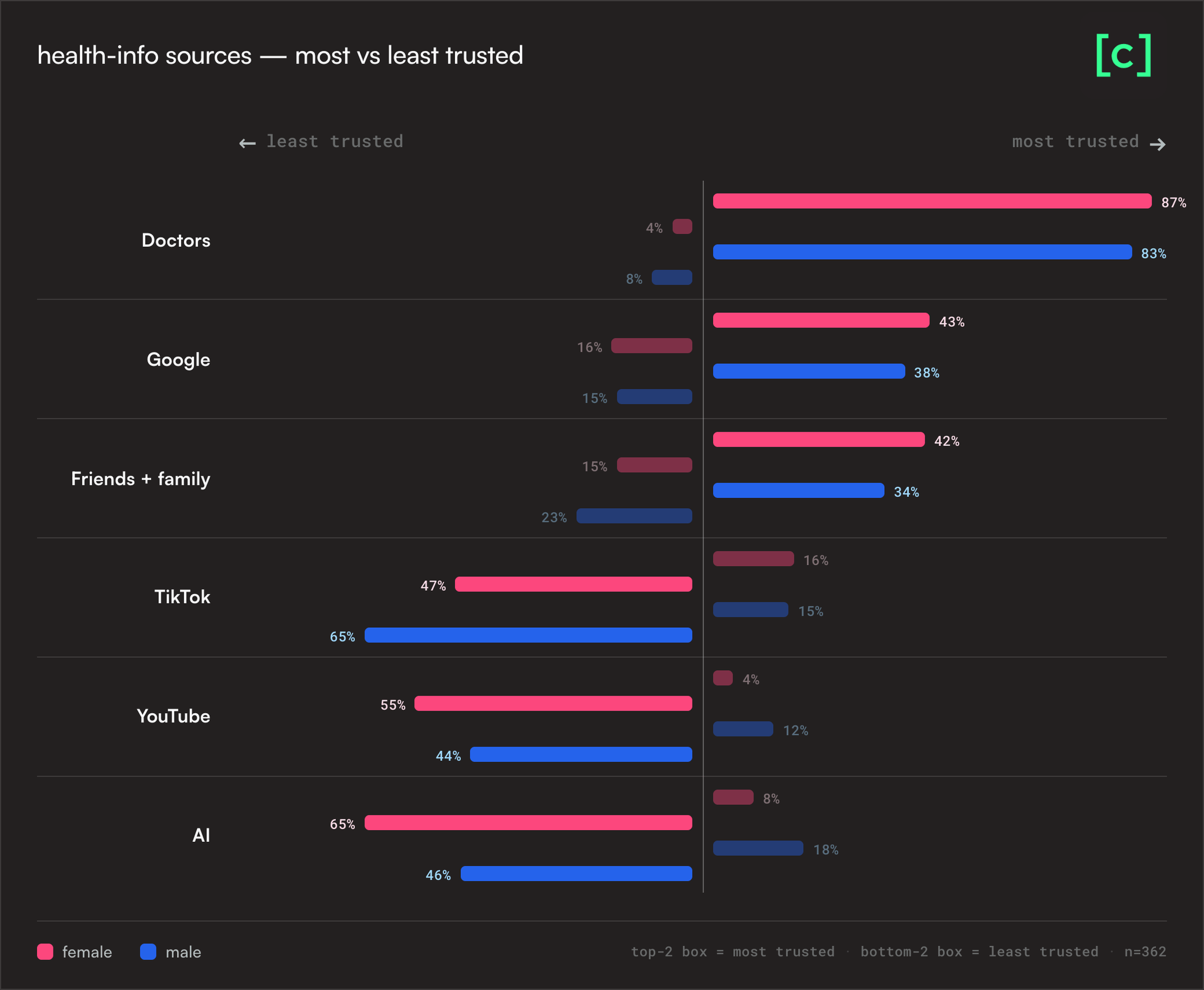
- Doctors are the one source this generation still believes. 87% of females and 83% of males rank them most-trusted.
- Google and friends + family: nearly 4 in 10 across genders trust the “look it up, then ask a human” layer.
Females and males diverge on trust / distrust:
- Females trust AI for health info the least. Nearly 2 in 3 females (65%) rank chatbots as most-distrusted vs. 46% of males.
- Males are most wary of TikTok. 65% most-distrusted vs. 47% of females.
- Females distrust YouTube slightly more than males (55% vs. 44%).
Side Effects Include Hallucinations
Gen Z + Alpha are skeptical of AI generally, and that skepticism sharpens around health.
Core concerns include hallucinations, sycophancy bias, and data privacy. Some view AI as the WebMD spiral, upgraded – ask about your symptoms and it will convince you you’re dying.
Some are open to AI at the right time, in the right hands.
- 1 in 4 are open to AI for mental health. Males are nearly twice as likely to be open than females (36% vs. 21%). Among the open minority, AI is a venting outlet and a thought-organizer, but never the therapist.
- Some trust AI for pre-doctor triage to narrow symptoms before a visit: is this normal? What could this be?
- Emerging signal: some would trust AI in a clinician’s hands, assisting the professional or navigating care and dosing, but never as the decision-maker.
“mental health and actual serious ailments in diagnosis…like if i feel like i have something i’m not gonna trust ai to diagnose me, i’m gonna maybe help use ai as a search engine to narrow down what i may have so i can present my suspicions to a doctor, right? and again, mental health. like why would i go vent into an ai bot? it’s gonna just reaffirm me if my delusions are incorrect or if i’m doing something wrong. it’s just gonna reaffirm me. and now some freaking tech billionaire bajillionaire company has my deepest darkest worries.”0:00
“Sometimes I will ask ChatGPT a quick, vague question just to get some guidance on it after maybe five or six opinions from my friends, just to get something unbiased and third-party quick, but not for life-altering mental health challenges.”0:00
“Oh, AI should never be trusted for diagnoses. I think that’s pretty self-explanatory but like just the fact of like you know like hallucinations isn’t always a like issue I have with AI telling when it tells you things that don’t actually make any sense or don’t exist and so for diagnosing health issues I think there’s just so many ways that it could go wrong so yeah”0:00
“A lot. I don’t want to give much personal data to it. I don’t want to deal with mental health issues. People have committed suicide because of AI. And again, like, I just, ugh, AI stinks. Garbo, poopy baby bad. Okay? Like, a Google search is usually fine. AI is unnecessary in this sort of stuff. I would rather go to a person for health advice, a person that I can speak to and ask specific questions and get either answers from personal experience, answers from a doctor who has medical training. Because, you know, WebMD and AI can’t be trusted at face value.”0:00
Claude, Build Me a Plan
When it comes to health, AI is welcome as the planner: the workout approach, the meal plan, the schedule.
35% of Gen Z + Alpha trust AI to generate a workout, meal, or diet plan. It’s the single most-accepted use case.
For many it’s already a habit, not a hypothetical — especially among males and those who lift.
“I trust AI to make me plans, like make me meal plans, workout plans, stuff like that like run this much in this way just to optimize like efficiency and like my like like optimize my strength not strength but optimize my like endurance to make sure I’m not like burning out every day from doing the same workouts and you know just to generally make me make me a workout and meal plan now AI is great at that kind of stuff.”0:00
“I think I would trust AI to help me like come up with a workout plan maybe of just like a weekly schedule of like what workouts to do on what day and then maybe like specific circuits to do within that but I don’t really know if I would trust it to help me like diet things like that I don’t know I have a hard time with that”0:00
“i’d trust ai to make a “perfect” macro plan. it’s good at math”
Feed(ing) Comparison
For most Gen Z + Alpha, caring about health started at home. But for some, it started on the feed.
- The on-ramps are overwhelmingly IRL and personal: playing sports, an early health scare, watching a parent or grandparent’s health decline, a family history of disease, or simply how they were raised.
When asked when they starting caring about their health, a notable subset trace the inflection point to comparing themselves to bodies on social media.
- Females mention beauty influencers and males mention TikTok creators and bodybuilders.
- Asked how they feel after 30 minutes of scrolling Instagram, 64% of females come away drained, with some describing a hit to their self-image: “insecure,” “bad about myself,” “not skinny like the model.”
Some are now unlearning what the algorithm taught them. They are rebuilding a more holistic definition of “healthy”: energy, peace of mind, and feeling good in their own skin.
“It came from a place of insecurity. So I always cared about my health, but I never really actually cared about my health. I never watched my calorie intake. I never cared about my physique. I never cared about anything until I got older, and it’s how I perceived myself. It came from insecurities, from how I perceived myself to other people at first. Then ultimately, it was just, it made me feel good. It gave me energy to go to work, it gave me energy to get up, it gave me energy to do hobbies that I would do that I wouldn’t do based off the simple fact that I wasn’t healthy. I didn’t have the energy, or the will, or the time.”0:00
“Um, you know, I hate to say this, but everything has to do with body dysmorphia, you know, not trying to say I have like, you know, chronic body dysmorphia, but everyone has a little bit of body dysmorphia, which is normal, because we see online with all these fitness influencers and these people with like, you know, amazing looking bodies with like, you know, crazy abs or crazy muscles, this and that, you know, it’s like, everyone wants to achieve that sort of lifestyle. And then it’s honestly, I think it’s a beneficial thing, because then they post these things and it motivates you, you know, so like, definitely for me started with social media, I saw online or like, you know, my friends were like, you know, had bigger busted biceps than me. And I’m like, dang, how do I do that? You know, and I was like, you can look online and find a workout plan. So like that, and then you just like, boom, there you go, you’ve already started.”0:00
“I think growing up as a young girl, especially with short-form content becoming growingly more popular and beauty influencers really taking off when I was a teen, I think it was just kind of ingrained into what it meant to exist as a young woman. Maintaining that beauty, maintaining that wellness. So I feel like I almost naturally fell into those interests and wanting to take care of myself.”